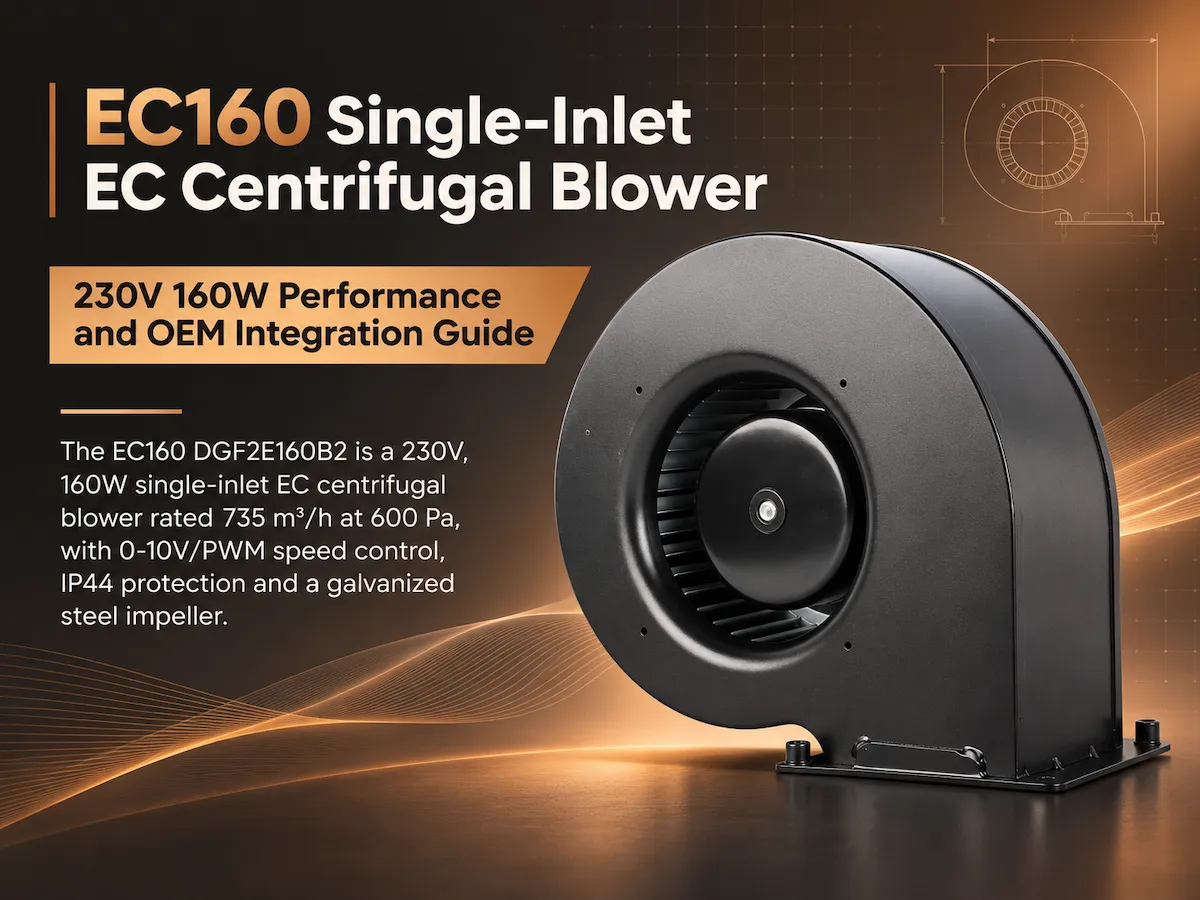
The EC160 DGF2E160B2 is a single-inlet EC centrifugal blower that runs on 230 VAC at 50/60 Hz and delivers 735 m³/h at 600 Pa, drawing 1.2 A and 160 W at 2,250 rpm. That puts it in the working range of condensing boiler casings, air-handling modules and equipment cooling plenums.
An EC centrifugal blower is a centrifugal fan driven by an electronically commutated brushless motor, with the drive electronics built in. So you send it a 0-10 VDC or PWM signal and the motor changes speed itself. No external VFD, no separate controller in your cabinet.
The EC160 uses a brushless DC external rotor motor rated IP44, insulation class B, and it takes its speed command from that same 0-10 VDC / PWM input. E-POWER has manufactured fans and motors for heating, medical, industrial air-treatment and ventilation equipment since 2001. The EC160 DGF2E160B2 ratings and drawings sit on its product page.
What are the EC160 DGF2E160B2 specifications at 230V?
One rating set covers the EC160, and it's all in the table below. E-POWER's DGF2E160B2 is the 230V EC centrifugal blower 160W model in this frame size, cataloged as an EC blower 735 m3/h 600 Pa at 2,250 rpm. Check your duty point against those numbers first. Drawings come later.
| Parameter | EC160 / DGF2E160B2 |
|---|---|
| Rated voltage | 230 VAC |
| Frequency | 50/60 Hz |
| Rated current | 1.2 A |
| Rated power | 160 W |
| Rated speed | 2,250 rpm |
| Airflow | 735 m³/h |
| Air pressure | 600 Pa |
| Noise level | 71 dBA |
| Operating ambient temperature | -25 °C to +60 °C |
| Net weight | 3.2 kg |
| Impeller | Galvanized steel impeller |
| Motor | Brushless DC external rotor |
| Protection rating | IP44 |
| Insulation class | Class B insulation |
| Speed control | 0-10 VDC / PWM |
Two figures decide whether the EC160 gets into your design: 735 m³/h of airflow and 600 Pa of static pressure. Find a duty point that sits inside both and you have a machine worth asking for a quotation on. Weight is the other practical check. At 3.2 kg it hangs inside most air-handling cabinets without extra framing, and because the external rotor motor drives the impeller directly at 2,250 rpm, there's no belt to align or replace.
Noise is the number that rarely survives installation. 71 dBA is what the blower itself contributes; the cabinet, the duct run and the discharge restrictions add to it. Plan for that before you promise a sound level to the end user.
EC160 vs EC140, EC133 and EC108: which 230V EC centrifugal blower fits the duty point?
Four single-inlet frames, one voltage, four power steps: 53 W, 62 W, 110 W, 160 W. Pressure separates them.
- EC160 (DGF2E160B2): 735 m³/h at 600 Pa, 2,250 rpm. Take it when the filter loads, the duct bends twice or the coil is dense. Smaller impellers stall earlier, so a 108 mm or 133 mm wheel can run out of static pressure long before it runs out of airflow.
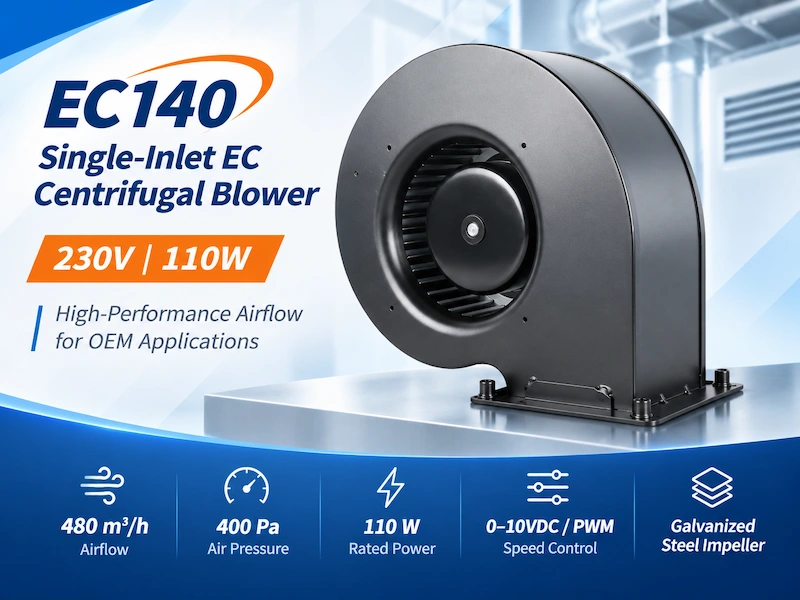
- EC140: 110 W, the middle step. Its published ratings are on the EC140 110 W model page, and E-POWER will confirm the frame against your duty point on request.
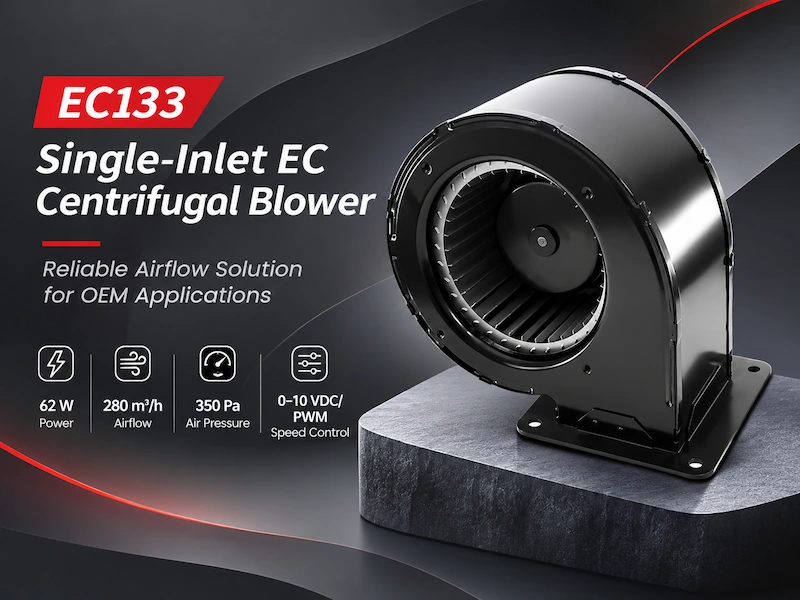
- EC133: 62 W. The EC133 EC centrifugal blower fits compact air-handling boxes where current draw and noise beat pressure headroom.
- EC108: 53 W. It's the smallest of the four, and the one for equipment cooling rather than ducted runs.
Verdict: the EC160 is the frame to look at when the duty point moves above roughly 450 Pa or 600 m³/h. Below that, EC140 is the 110 W step.
Single-inlet or double-inlet EC centrifugal blower for air-handling equipment?
One eye or two? A single-inlet impeller draws air through one central inlet and discharges it around a single scroll. A double-inlet wheel has two eyes and a wider housing feeding a common outlet.
Double-inlet gives roughly double the flow at a similar diameter, and that's its main argument. Against it: inlet clearance on both sides, a wider footprint, and ductwork at two faces of the cabinet. Single-inlet packs into tighter envelopes — one inlet plane, simpler bracketing. Blade geometry sets static pressure more than inlet count does.
The EC160 DGF2E160B2 is a single-inlet frame rated 735 m³/h at 600 Pa, with a galvanized steel impeller, and it weighs 3.2 kg. Fewer than 800 m³/h suits plenty of OEM cabinets.
When it doesn't, the smaller frames cover the step-downs: the EC140 at 110 W, the EC133 at 62 W and the EC108 at 53 W, all on 230 V. Check the EC160 DGF2E160B2 product page for the drawing, and how these blowers slot into OEM equipment if your 230 V OEM duty point falls near that curve.
Where the EC160 fits: ventilation, air handling, heating and equipment cooling
Say an air-handling unit needs 700 m³/h at 500 Pa, a 230V supply, and a 0-10V command from the building management system.
The EC160 (DGF2E160B2) is rated 735 m³/h at 600 Pa from 230 VAC, pulling 160 W at 2,250 rpm. That duty point sits inside the cataloged envelope with a little headroom. Check the 71 dBA against your acoustic target, and the -25°C to +60°C ambient range against the plant room.
- The 0-10 VDC / PWM input lets the BMS trim airflow without an external VFD. Less panel space, less wiring.
- Single-inlet geometry fits a tight cabinet when the inlet has clear space and the outlet ducts straight out.
- A galvanized steel impeller and IP44 protection hold up in dusty cooling duty inside an equipment enclosure.
- Net weight is 3.2 kg, light enough for one installer to lift into place.
Ventilation is the obvious job. Used as an OEM ventilation blower inside an air-handling cabinet or a rooftop unit, the EC160 moves 735 m³/h and stays under the 600 Pa ceiling, and the 0-10 VDC / PWM input lets the controller ramp it down overnight instead of cycling a contactor.
Equipment cooling blower duty looks different: an enclosure, a heat-exchanger stack, a cabinet that wants positive pressure. Grit and dust are the usual problem there, so the IP44 motor and the galvanized impeller matter more than the headline airflow. Mind the 71 dBA if the cabinet sits next to an operator.
Heating is where buyers overreach. The EC160 can serve heating and air handling, but on a condensing boiler or burner it doesn't set the gas-air ratio by itself. Use a dedicated gas blower from the range, and have the OEM prove the burner through system-level testing.
If 735 m³/h is more than your duty needs, the same single-inlet layout comes in smaller sizes: EC140 at 110 W, EC133 at 62 W, EC108 at 53 W.
Have a duty point to check? Ask E-POWER for a quotation or a sample of the EC160. Send five things with the request: the target duty point (airflow and static pressure), supply voltage, control signal (0-10 VDC or PWM), mounting orientation, and the approval conditions your equipment has to meet. The team reviews it against the published EC160 ratings and replies. The form is on the E-POWER contact page.
230V EC centrifugal blower or 24V DC: which supply voltage should your equipment use?
A 24 V supply isn't the safe default people assume it is. Add the power supply, the thicker cable for the same watts and one more thing that can fail in the field, and the cheap option gets expensive.
| Decision factor | 230 VAC mains (EC160, DGF2E160B2) | 24 V / 48 V DC |
|---|---|---|
| Power source | Direct from the appliance mains inlet | Separate PSU sized with headroom |
| Rated current at 160 W | 1.2 A at 230 V (published rating) | About 6.7 A at 24 V (arithmetic from 160 W, not a published rating) |
| Cable run | Thin conductor, long runs are fine | Short route, heavy gauge |
| Speed signal | 0-10 VDC or PWM into the onboard electronics | Same 0-10 VDC / PWM options |
| Protection | IP44, brushless DC external rotor | IP44 DC variants available |
| Fit | Units already on mains: boilers, AHUs, ventilation | Battery, mobile or low-voltage-only enclosures |
Size the run on the EC160's 1.2 A rated current, not on a back-of-envelope watts-over-volts sum, and a thin conductor to a remotely mounted blower is unremarkable. Same 160 W on a 24 V rail is a different cable entirely: the current climbs toward 6.7 A, voltage drop starts to bite over any distance, and you're paying for copper twice over.
So for an OEM centrifugal blower 230V build, the mains EC160 saves the PSU and the copper. Keep EC fan speed control identical either way — the same 0-10 VDC command works on both.
Standards paperwork lands on the equipment builder. EC blowers are commonly assessed alongside IEC 60335-1, which covers safety of household and similar electrical appliances, and the IEC 61800 series for adjustable-speed electrical power drive systems. In the EU, fan eco-design falls under Regulation (EU) 327/2011. E-POWER makes no certification claim under any of these documents. Which ones apply to your appliance, and how the fan is folded into that assessment, is confirmed by the builder integrating the blower.
How do 0-10V and PWM speed control work on an EC centrifugal blower?
The EC160 DGF2E160B2 carries its drive on the motor. Mains 230 V goes in, the onboard electronics rectify it and commutate the brushless DC external-rotor motor at whatever speed the command asks for. No external VFD, no shielded motor cable run back to a cabinet. That is EC fan speed control at its simplest: feed 0-10 VDC or a PWM duty cycle and airflow follows the signal.
Put the control signal in the specification on day one. A 0-10V PWM EC blower specced late gets a controller bolted on afterwards, and builders then argue over who owns the ramp, the enable line and the fault response. State signal type, source and failure position (full speed or stop?) before you freeze the harness.
What the EC160 is built from: galvanized steel impeller, brushless DC external rotor and IP44 protection
A parts list tells you what's inside the DGF2E160B2. It won't tell you how long the blower lasts in your cabinet. Read the build for what each item actually does.
- Galvanized steel impeller. Zinc coating on the wheel, not paint. That's what resists corrosion on the sheet steel, and on a part spinning at 2,250 rpm you don't want coating flaking off into the airstream.
- Brushless DC external rotor. No brushes, so no carbon dust in the winding. The impeller rides on the motor's outer can, which keeps the whole stack short enough to sit inside a tight cabinet footprint.
- IP44. Solid objects down to 1 mm and splashes from any direction stay out (the IP code is defined in IEC 60529). Mount it near a condensate line without boxing it in a second enclosure.
- Class B insulation. Rated 130 °C under IEC 60085. E-POWER publishes -25 °C to +60 °C ambient for this model, so anything hotter than that is outside the stated range for the blower, whatever the insulation class is rated for.
- 3.2 kg net. That's the load your bracket and cabinet gauge have to carry. Worth checking before the sheet metal gets cut.
None of the above is a life rating. Service life and warranty on the EC160 depend on the application — duty point, ambient temperature, duty cycle, mounting orientation — so confirm them for your system instead of reading them off the parts list. If you're running combustion equipment, the OEM settles suitability through system-level testing anyway; the blower alone doesn't set the gas-air ratio.
How do you mount and duct the EC160 inside an OEM cabinet or air-handling unit?
Start at the outlet. Clock the scroll so the discharge points straight into the duct run.
A 90° elbow bolted right onto the flange costs more static pressure than the bracket steel ever will. Skip the elbow if the layout lets you.
Then give the inlet real room. One and a half times the inlet diameter of clear space is the rule of thumb.
A flat panel sitting 20 mm off the eye will strangle an EC centrifugal blower rated at 735 m³/h. That clearance gets ignored more often than any other dimension.
Bolt the 3.2 kg body to a stiffened cross-member, not 1 mm sheet.
At 2,250 rpm a floppy bracket sings, and the cabinet amplifies it. Rubber isolators under the feet handle the rest.
Ambient range is -25 °C to +60 °C, so keep the motor out of the hot airstream.
Take mounting orientation from the model-specific installation drawing on the EC160 product page rather than a generic air handling blower layout.
OEM and ODM customization: what can E-POWER change on a 230V centrifugal blower?
Dimensions, performance, impeller material, control configuration. Those four are the real levers on an OEM centrifugal blower 230V order, and all of them sit inside E-POWER's customisation scope.
- Dimensions: frame, inlet ring and outlet position matched to your cabinet, so the blower drops into the cutout you already have.
- Performance: airflow and static pressure trimmed to your duty point, rather than throttling a 735 m³/h EC centrifugal blower down with a damper.
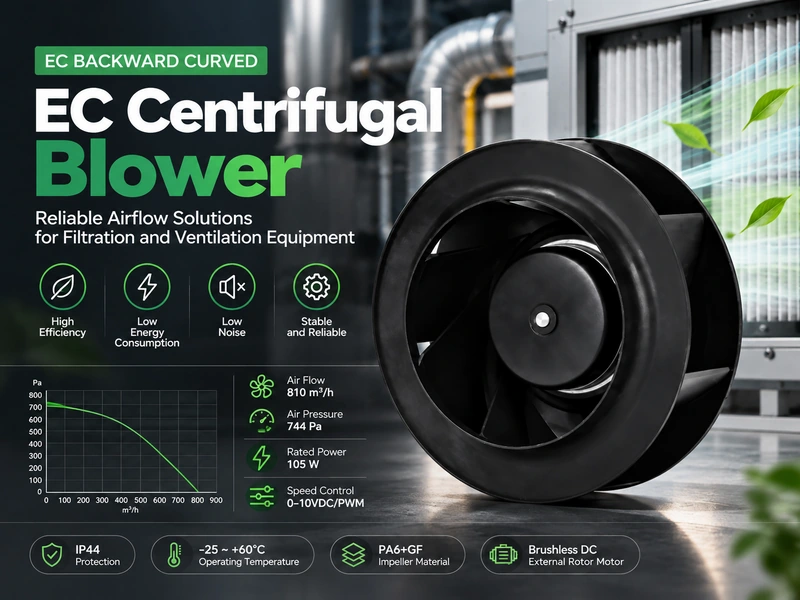
- Impeller material: galvanized steel, PA6+GF or metal, chosen for operating temperature and duty cycle.
- Control: 0-10 VDC or PWM, 230 VAC or 24V/48V DC variants, IP44 enclosure. The electronics follow your controller.
On boiler work, E-POWER can be qualified as an additional source for OEM production, subject to an approved specification and the OEM's own qualification. Qualification is the operative word. The blower alone doesn't set the gas-air ratio; suitability for combustion equipment comes from system-level testing at the OEM, and the approval conditions that fall out of that testing belong in the specification before anything gets built.
Approval runs on five RFQ items, and each one settles a different part of the design. The target duty point comes first: your airflow and static pressure, measured across the system you're actually building rather than a bare fan on a bench.
Electrical is supply voltage and the control signal, 0-10 VDC or PWM, so the 160 W brushless DC external rotor in the EC160 is driven by your own controller and not a separate driver board.
Mechanical is mounting orientation and the cabinet cutout, which decides whether the scroll discharges left, right or up.
Required approval conditions come last, and they're the ones that can send a design back to the start — the approval route your market demands, and the evidence that has to sit alongside it.
The catalogued EC160 numbers are 735 m³/h, 600 Pa, 2,250 rpm at 230 VAC, 160 W, part number DGF2E160B2. Compare them with the resistance of your own ductwork and cabinet. Where a duty point sits well below that rating, the EC160 is more blower than the job needs, and the EC140 at 110 W or the EC133 at 62 W is the smaller frame to discuss with E-POWER. Send your duty point with the RFQ so the frame can be confirmed there.
Sign-off starts with those five lines, all of them on one sheet: target duty point, supply voltage, control signal, mounting orientation, required approval conditions. That's what E-POWER needs in order to quote, and an approved specification can be requested with the RFQ at the same time.
Want a quotation on your platform? Request a quotation or an EC160 sample, and send the five items with it: target duty point, supply voltage, control signal, mounting orientation and required approval conditions. Those five lines are enough to start.
What actually drives the price of an OEM centrifugal blower build?
Most of the unit price of this EC centrifugal blower sits in the 160 W brushless DC external-rotor motor and its integrated 0-10V/PWM electronics.
On price, the rest of the build is secondary. Impeller material decides what the wheel can handle in service.
Galvanized steel sheet is the EC160's standard wheel. It takes higher airstream temperatures than a PA6+GF moulding and holds its shape under sustained load.
PA6+GF brings moulded repeatability and better resistance to humid or mildly chemical air. Steel depends on coating integrity at cut edges and fixings.
Balance stability over life comes down to wheel stiffness and how the hub is fixed; both materials can deliver it when the build is right.
Match the material to your duty point. Hot, high-pressure work points to steel. Wet or cleaning-agent exposure points to glass-filled polymer.
Custom dimensions or a re-tuned performance point add engineering time before the first unit ships. Non-recurring engineering (NRE) covers that work.
Who owns the drawing matters just as much. Pay for a new impeller profile or a modified housing and you'll want the files and the right to move them.
Running cost sits elsewhere. 160 W at 2,250 rpm and 71 dBA is quiet for the airflow, so duct-borne noise treatment shrinks.
IP44 limits ingress at the motor enclosure. The brushless external rotor has no brushes. Both are construction details you can check on the unit and its model-specific drawing.
Key Takeaways
- The EC160 (DGF2E160B2) is catalogued at 735 m³/h and 600 Pa on 160 W, from a 2,250 rpm brushless DC external-rotor motor drawing 1.2 A.
- 230 V supply and 0-10 VDC / PWM control sit inside the blower. No external VFD to buy, mount or wire.
- Single-inlet means one ducted outlet. Sheet metal and duct runs stay simple, and the impeller is galvanized steel sheet.
- IP44, Class B insulation and a -25 °C to +60 °C ambient range cover cold inlets and damp plant rooms.
- Those two figures are catalogued maxima, not a guaranteed simultaneous duty point. Match the model's performance drawing to the airflow and static pressure your system really needs.
- Need less air? The EC108 at 53 W, EC133 at 62 W and EC140 at 110 W run the same 230 V single-inlet layout.
Request a quotation or a sample, and put four things in the message: target duty point, supply voltage, control signal, mounting orientation. Those four decide the frame size, the control configuration and how the unit arrives on your line.
Frequently Asked Questions
Will one blower cover my duty point?
Only your system curve answers that. 735 m³/h at 600 Pa is the point the EC160 product page lists, and a single point doesn't tell you where the fan sits at 400 Pa or at 650 Pa. Add the filter, the duct run and the outlet grille, and the fan settles where the two curves cross.
A duty you measured at 500 Pa on a clean unit can pass 600 Pa once the filter loads. If the crossing lands above the published pressure, step up a frame instead of over-speeding a 160 W motor. Ask E-POWER for the performance drawing against your own duty point before you commit to the frame.
How do I command the speed?
Feed 0-10 VDC or a PWM duty cycle into the integrated electronics. No external VFD is needed. Fix the signal type in the specification before cabinet wiring is frozen; swapping a 0-10 V lead for a PWM drive after the panel is built means new terminals and a new drawing.
Can the airflow and static pressure curve of a single-inlet centrifugal blower be customized?
Yes, inside the frame and motor limits. Impeller diameter and width, blade angle and the rotor's speed ceiling set what's reachable. A 160 W motor only stretches so far before the next frame size is the better answer. E-POWER's performance customization covers airflow and static pressure targets on OEM orders, and the control configuration can be matched in the same build. Send the duty point with the tolerance you actually need, plus supply voltage and signal, and you get a curve back rather than a single number.
Can EC centrifugal blower dimensions be customized to fit an existing air-handling unit?
Yes, and that retrofit case is what dimension customization at E-POWER exists for: outlet flange pattern, mounting holes, scroll orientation and overall depth can be set to the cutout already punched in your panel. Send a dimensioned drawing of the opening and the panel thickness, not a photo. The bolt circle and the clearance behind the wheel decide whether the unit drops in. A drop-in replacement is a new drawing and usually a new tooling step, so plan it as a project rather than a spare-part order.
How long does tooling take for a custom single-inlet centrifugal blower?
Tooling time is quoted per project; E-POWER doesn't publish a standard figure for it. Four steps run in this order: freeze the drawing, build the tooling, run samples, approve. Nobody sensible cuts metal before both sides sign the drawing, because a 2 mm shift in the outlet flange after the die exists is an expensive conversation.
How long it takes depends on how far the frame departs from the standard range (a new hole pattern is quick, a new scroll is not), and the clock starts from the approved specification and signed drawing, not from the inquiry date. Volume decides the production slot after that. For a boiler OEM second source, overlap qualification with your current supplier to cut schedule risk. Approval means you have run the sample on your own bench.
How is balancing quality controlled on single-inlet centrifugal blower impellers?
A single-inlet wheel carries most of its mass on the inlet-ring side, so it's balanced as a complete rotating assembly, in two planes where the design allows. Correction is by removing material or adding weights at the rim or backplate, then the rotor is checked again on the shaft it will ship on, since a wheel trimmed on one shaft can still vibrate on another.
What you should get with the sample is a balance record for the complete rotor and the grade stated against the approved specification. ISO 21940-11, which replaced ISO 1940-1, is the usual reference for balance grades, and the record has to name the one your drawing calls for. That figure comes from your engineering sign-off, not from a catalog page. The EC160 impeller is galvanized steel sheet, which holds shape at 2,250 rpm and shrugs off heat soak in heating equipment.
Is the MOQ lower for standard DC centrifugal blowers than for customized OEM blower models?
Minimum order quantity is set per quotation, because it moves with model, configuration and annual volume. An EC108 or an EC133 at 230 V and a fully custom build don't share one figure. Send the duty point and the annual volume you expect, and the quote comes back with the number for your part.
What is the carton size and gross weight for a 230V EC centrifugal blower?
Net weight of the EC160 (DGF2E160B2) is 3.2 kg. Carton dimensions and gross weight follow the packing configuration on your order. A single box and a multi-pack with foam inserts don't share either number, so the packing data is issued per configuration with the order documents. Pull that figure before you book transport; freight class and the shelf or crate the unit lands on both depend on it.
Can I use the EC160 on a gas burner?
For burner air, start from a gas blower rather than a general ventilation unit. E-POWER builds an EC gas blower range for combustion equipment, and D-RG148 is one model in it. Whichever unit you pick, the blower alone doesn't set the gas-air ratio, and no burner rating comes off a fan datasheet. Prove the burner at system level: firing rate, gas train, air damper and flue together, with the OEM signing off the result.
What ambient range applies, and what should I send for a quotation?
Operating ambient is -25 °C to +60 °C, so keep inlet air inside that window. For a quotation, send the duty point, supply voltage, control signal, mounting orientation and the approval conditions the unit has to meet. Those five items separate a usable quote from a catalog number.
Send them through the E-POWER contact page and you'll get a reply against your duty point rather than a generic brochure.