
Choosing the right EC centrifugal blower manufacturer is essential for OEMs developing industrial air filtration, HVAC equipment, solder fume extraction systems, and commercial ventilation products.
One of the biggest engineering challenges is maintaining adequate airflow as filters accumulate dust and system resistance increases.
A blower may deliver sufficient airflow with a clean filter but experience a significant performance reduction as the filter becomes loaded.
The correct EC centrifugal blower must meet the equipment's required airflow at both initial and final filter resistance while providing compatible speed control, acceptable noise, and reliable operating performance.
Ningbo E-POWER Energy Saving Technology Co., Ltd. manufactures EC centrifugal fans, motors, and electronic control solutions for OEM equipment manufacturers.
Its EC centrifugal blower product range includes forward- and backward-curved configurations designed for different airflow, pressure, and installation requirements.
This guide explains how to evaluate blower performance, compare product models, select suitable control methods, and qualify an EC centrifugal blower manufacturer for long-term OEM production.
What Is an EC Centrifugal Blower?
An EC centrifugal blower combines a centrifugal impeller with an electronically commutated motor and compatible electronic control circuitry.
The motor uses electronic commutation rather than mechanical brushes, allowing adjustable-speed operation.
Air enters the centrifugal impeller near its center and moves outward through the rotating blades.
The impeller and surrounding equipment geometry determine how the blower develops airflow and pressure.
For industrial OEM applications, EC centrifugal fans can offer several advantages:
-
Adjustable airflow through supported control interfaces.
-
Electronic motor speed management.
-
Integration with equipment control systems.
-
Reduced power consumption under suitable part-load conditions.
-
Compact motor and impeller configurations.
-
Adaptability to changing operating requirements.
However, motor technology alone does not guarantee low energy consumption or stable airflow.
Actual performance depends on the impeller design, fan curve, control strategy, operating point, and connected air system.
Why Does Filter Loading Matter in EC Blower Selection?
Industrial filtration equipment usually contains filters, ducts, housings, bends, and air inlets that create resistance to airflow.
As a filter captures particles, its pressure drop typically increases.
This changes the resistance experienced by the blower.
If fan speed remains unchanged, airflow may decrease as resistance rises.
For equipment designed to capture welding fumes, solder smoke, or airborne dust, insufficient airflow can reduce extraction performance.
Clean Filters vs. Loaded Filters
| Operating Condition | System Behavior | Blower Requirement |
|---|---|---|
| Clean filter | Relatively low filter pressure drop | Deliver required initial airflow |
| Partially loaded filter | Increasing system resistance | Maintain acceptable airflow |
| Final filter resistance | Highest permitted filter pressure drop | Meet minimum required duty point |
| Filter replacement | Resistance decreases | Avoid unnecessary airflow or excessive speed |
OEM engineers should select a blower based on the full filter operating range, not only clean-filter conditions.
The final allowable filter pressure drop should be defined by the filter manufacturer and equipment design.
A suitable blower must be evaluated using its complete airflow-pressure performance curve.
For related application information, see E-POWER's EC Centrifugal Blower Applications Guide.
How Do Airflow and Static Pressure Affect Blower Performance?
Two parameters determine whether a centrifugal blower can meet a system requirement.
Airflow (m³/h) measures the volume of air moving through the system.
Static pressure (Pa) describes the pressure associated with overcoming resistance in the connected airflow path.
Maximum airflow and maximum static pressure are different points on a blower's performance curve.
They should not be interpreted as simultaneous operating values.
The actual operating point depends on the intersection of the fan performance curve and the system resistance curve.
Example: Industrial Filtration Equipment
Consider a hypothetical filtration machine with these design requirements:
| Design Parameter | Example Requirement |
|---|---|
| Required operating airflow | 600 m³/h |
| Clean-filter pressure drop | 180 Pa |
| Final filter pressure drop | 350 Pa |
| Other system pressure losses | 120 Pa |
| Total clean-system resistance | 300 Pa |
| Total final-system resistance | 470 Pa |
These values are illustrative engineering assumptions, not E-POWER product test results.
In this example, the blower must provide approximately 600 m³/h against 470 Pa if the equipment is required to maintain that airflow through the full filter service interval.
A catalog rating of 800 m³/h maximum airflow and 700 Pa maximum pressure does not prove that the blower can achieve this operating point.
The engineering team must examine the fan curve or request the relevant test data.
This distinction is important when comparing suppliers because products with similar headline ratings can have different performance at the required duty point.
Forward-Curved vs. Backward-Curved EC Centrifugal Fans
A professional EC centrifugal blower manufacturer should provide different fan designs or help customers understand which configuration suits their equipment.
E-POWER offers both EC Forward Centrifugal Fans and EC Backward Centrifugal Fans.
Key Differences
| Feature | Forward-Curved EC Fan | Backward-Curved EC Fan |
|---|---|---|
| Blade orientation | Curved in the direction of rotation | Curved against the direction of rotation |
| Typical application | Compact ventilation and air-handling assemblies | Industrial ventilation and filtration equipment |
| Pressure characteristics | Depends on housing and wheel design | Often suitable for systems requiring substantial static pressure |
| Installation | Frequently used in compact scroll-housed assemblies | Available in multiple centrifugal configurations |
| Efficiency | Depends on the complete design and duty point | Can offer high efficiency near the intended operating region |
| Selection priority | Compactness and system integration | Airflow-pressure performance and system resistance |
Neither design is universally superior.
For filtration equipment with changing pressure losses, backward-curved configurations are often worth evaluating.
However, the final decision must be based on the actual performance curves, installation requirements, and efficiency at the specified operating points.
E-POWER EC Centrifugal Blower Models Compared
E-POWER offers several EC centrifugal fan models with different impeller diameters, airflow ratings, pressure capabilities, and power requirements.
The following specifications are taken from published E-POWER product information.
| Model | Fan Design | Airflow | Air Pressure | Rated Power |
|---|---|---|---|---|
| EC Ø133-H55 | Forward-curved | 260 m³/h | 320 Pa | 62 W |
| EC Ø133 | Backward-curved | 470 m³/h | 475 Pa | 45 W |
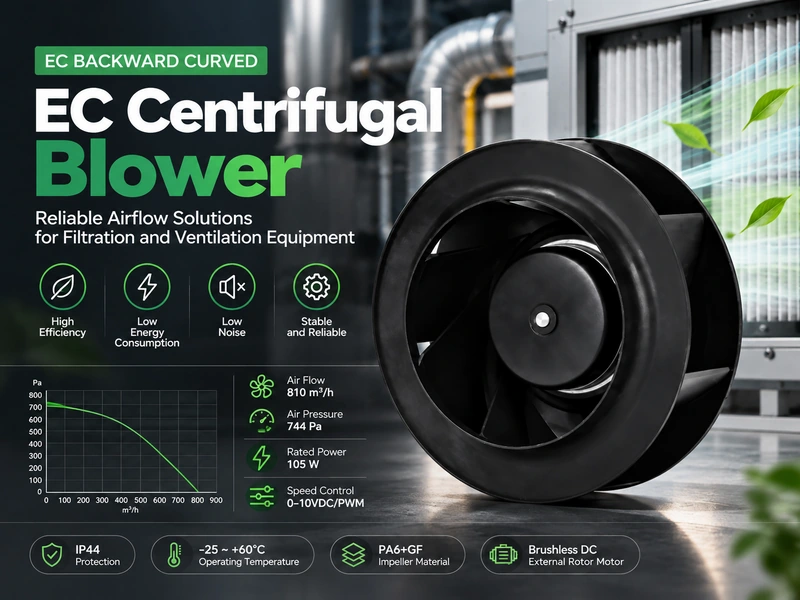
| EC Ø175 | Backward-curved | 810 m³/h | 744 Pa | 105 W |
| EC Ø225 | Backward-curved | 1,110 m³/h | 425 Pa | 85 W |
| EC Ø355 | Backward-curved | 3,500 m³/h | 805 Pa | 390 W |
Note: These are published catalog ratings and do not establish simultaneous airflow-pressure operating points. The listed configurations use 230 VAC. Confirm current performance curves, electrical specifications, and dimensions before selecting a model.
Which Model Should OEM Buyers Evaluate?
EC Ø133-H55: A compact forward-curved option for smaller ventilation assemblies where installation space and system requirements are important.
EC Ø133: A backward-curved fan platform for compact equipment requiring a different airflow-pressure characteristic.
EC Ø175: A candidate for filtration and ventilation equipment requiring a higher airflow range and substantial pressure capability.
EC Ø225: Suitable for preliminary evaluation in OEM air-handling applications where its specific airflow-pressure curve matches the equipment.
EC Ø355: A larger centrifugal fan platform for industrial air-handling assemblies requiring greater airflow capacity.
These descriptions are preliminary screening directions, not guaranteed application matches.
Actual selection requires performance-curve verification, mechanical checks, and equipment-level testing.
Additional drawings and information are available through the E-POWER Technical Catalog.
Can EC Blowers Maintain Constant Airflow as Filters Become Loaded?
EC motors provide electronic speed control, but an EC blower does not automatically maintain constant airflow.
Constant-airflow operation generally requires an appropriate control strategy and sufficient remaining blower capacity.
Three common approaches are used in OEM equipment.
1. Fixed-Speed Operation
The blower operates at a selected speed.
As filter resistance increases, airflow may decrease.
This arrangement can be suitable where airflow variation is acceptable and the blower has been selected with sufficient operating margin.
2. Adjustable-Speed Operation
The equipment controller changes blower speed using a compatible control interface.
This may allow the blower to compensate for changing system resistance.
However, the controller must receive appropriate information or follow an appropriately validated control strategy.
3. Closed-Loop Airflow Control
The system uses suitable measurement or estimation methods to adjust blower operation toward an airflow target.
Possible feedback inputs include airflow measurements, differential-pressure measurements, or a validated equipment-specific estimation model.
PWM or 0–10V control does not independently guarantee constant airflow.
The controller must be properly configured, and the blower must retain enough performance capacity to meet the required operating conditions.
What Electrical Specifications Should OEM Engineers Check?
E-POWER's published EC centrifugal fan configurations include brushless external-rotor motors and supported 0–10VDC/PWM speed control.
Before integration, equipment manufacturers should verify the following specifications.
| Electrical Parameter | OEM Verification Requirement |
|---|---|
| Rated voltage | Compatibility with equipment power supply |
| Motor power | Input power at relevant operating conditions |
| Control interface | 0–10VDC or PWM compatibility |
| Speed range | Required minimum and maximum operating speeds |
| Feedback | Available speed or status signal |
| Startup behavior | Response during equipment startup |
| Protection | Model-specific environmental protection |
| Wiring | Connector, pin assignments, and grounding |
For example, the EC Ø175 product page identifies a 230 VAC configuration, brushless external-rotor motor, 0–10VDC/PWM speed control, IP44 protection, and Class B insulation.
These features should be verified against the exact product revision.
OEM buyers should never assume that different EC fans have identical wiring or control characteristics.
What Materials and Components Influence Blower Reliability?
An EC centrifugal fan consists of several critical components, including the impeller, motor, bearings, supporting structure, and electronic controls.
Impeller construction can influence rotational balance, mechanical durability, noise, and operating behavior.
For example, E-POWER publishes the following materials for selected models:
| Model | Published Impeller Material |
|---|---|
| EC Ø133-H55 | Galvanized metal sheet |
| EC Ø133 | PA6+GF |
| EC Ø175 | PA6+GF |
| EC Ø225 | PA6+GF |
| EC Ø355 | Aluminum alloy sheet |
PA6+GF refers to glass-fiber-reinforced polyamide.
Material selection should consider operating temperature, moisture, contaminants, vibration, and the mechanical requirements of the equipment.
For industrial filtration applications, buyers should also consider whether dust or other contaminants can reach the impeller or motor.
Where corrosive, combustible, or hazardous substances are present, application-specific engineering and safety requirements must be evaluated.
An ordinary catalog blower should not be assumed suitable for explosive atmospheres or hazardous materials without appropriate assessment and certification.
How Should an EC Centrifugal Blower Manufacturer Demonstrate Quality?
Manufacturing consistency is essential when a fan becomes part of an OEM production platform.
A professional supplier should have documented processes for material inspection, motor assembly, impeller balancing, electrical testing, and finished-product verification.
According to E-POWER's company and manufacturing information, its capabilities include motor and PCB development, automated winding, precision assembly, dynamic balancing, airflow testing, and reliability evaluation.
For supplier qualification, OEM buyers should focus on model-specific evidence.
Recommended Quality-Control Checklist
| Quality Area | What Buyers Should Request |
|---|---|
| Incoming inspection | Component and material inspection procedures |
| Motor manufacturing | Electrical and assembly inspection requirements |
| Impeller balancing | Defined balancing and vibration controls |
| Airflow verification | Performance testing information |
| Electrical safety | Relevant test methods and applicable documentation |
| Reliability | Aging or endurance testing information |
| Production consistency | Approved specifications and inspection criteria |
| Change management | Product revision and notification procedures |
ISO 5801:2017 and ANSI/AMCA 210-25 / ASHRAE 51-25 describe recognized methods for determining fan aerodynamic performance under standardized laboratory conditions.
These standards can help OEM engineers discuss test methods and the comparability of published data.
They should not be presented as proof that a particular E-POWER product has been certified under those standards.
What Should OEMs Test Before Approving a Blower?
For industrial filtration equipment, testing should represent actual operating conditions.
A practical qualification plan includes:
Clean-filter performance: Verify airflow, pressure, input power, and noise under initial resistance conditions.
Loaded-filter performance: Evaluate whether the blower meets the minimum required airflow at the defined final filter resistance.
Control response: Test the applicable 0–10VDC or PWM interface, feedback behavior, and speed adjustment.
Thermal performance: Check motor and electronic temperatures during representative operating periods.
Noise and vibration: Evaluate installed acoustic and mechanical behavior.
Mechanical integration: Confirm mounting, inlet and outlet conditions, wiring clearance, and maintenance access.
Production repeatability: Compare approved samples with subsequent production units.
Installation geometry matters because inlet disturbances, outlet restrictions, and nearby fittings can affect installed performance.
ISO/TR 16219:2024 addresses the difference between standardized fan testing and performance under actual installation conditions.
For this reason, laboratory fan curves should be complemented by completed-equipment validation.
What Are the Purchasing Costs and Risks?
For B2B buyers, a low initial blower price does not necessarily result in the lowest total cost.
| Purchasing Risk | Potential Consequence | Recommended Solution |
|---|---|---|
| Insufficient pressure capability | Reduced airflow with loaded filters | Evaluate final-resistance duty point |
| Incorrect control interface | Integration delays | Confirm electrical compatibility |
| Oversized blower | Unnecessary cost, noise, or energy use | Match the actual duty range |
| Mechanical mismatch | Installation modifications | Request approved drawings |
| Inadequate environmental suitability | Premature deterioration | Review operating conditions |
| Inconsistent production quality | Rework and equipment failures | Establish quality acceptance criteria |
| Undocumented product changes | Requalification expenses | Agree on change notification |
The total purchasing decision should include component cost, engineering effort, validation expenses, expected operating energy use, maintenance, and production reliability.
These costs depend on the application and cannot be determined from a catalog price alone.
Why Consider E-POWER for OEM EC Centrifugal Blower Projects?
Ningbo E-POWER Energy Saving Technology Co., Ltd. integrates motor engineering, electronic control development, fan manufacturing, and product testing.
Its EC centrifugal blower range includes multiple forward- and backward-curved designs for OEM equipment development.
For manufacturers of filtration and ventilation equipment, E-POWER can support discussions covering:
-
Product selection based on required airflow and pressure.
-
Electrical and speed-control compatibility.
-
Mechanical installation requirements.
-
Product customization feasibility.
-
Sample development and performance evaluation.
-
Quality requirements and volume-production coordination.
The appropriate model and customization scope depend on the customer's technical requirements.
MOQ, sample lead time, manufacturing schedule, and commercial terms should be confirmed for each project.
What Information Is Needed for an OEM Blower Quotation?
Before contacting an EC centrifugal blower manufacturer, buyers should prepare a complete technical inquiry.
| Required Information | Details |
|---|---|
| Equipment type | Air purifier, HVAC unit, industrial filter, or fume extractor |
| Target airflow | Required m³/h at the installed operating point |
| Clean-filter resistance | Initial filter pressure drop |
| Final filter resistance | Maximum permitted loaded-filter pressure drop |
| Other pressure losses | Ducts, bends, housing, and other components |
| Power supply | Required voltage and frequency |
| Speed control | PWM, 0–10VDC, or other specified requirements |
| Mechanical constraints | Fan dimensions, mounting, inlet, and outlet |
| Operating conditions | Temperature, humidity, contaminants, and duty cycle |
| Purchasing requirements | Sample quantity, annual volume, and project schedule |
Providing these details helps the supplier evaluate the application and reduce unnecessary quotation revisions.
Need an EC centrifugal blower for your OEM filtration or ventilation equipment?
Explore E-POWER's EC Centrifugal Fan Range or contact the E-POWER engineering team with your airflow, clean and loaded filter resistance, electrical requirements, and estimated order volume.
Frequently Asked Questions
1. What does an EC centrifugal blower manufacturer produce?
An EC centrifugal blower manufacturer produces centrifugal fans using electronically commutated motors and compatible control electronics. Products may include forward- and backward-curved designs for ventilation, air handling, and industrial equipment.
2. Are EC centrifugal blowers suitable for industrial filtration?
Yes, provided the selected blower meets the system's airflow-pressure requirements and environmental conditions. Performance must be verified at clean and final filter resistance.
3. Can an EC blower maintain constant airflow automatically?
Not necessarily. Constant-airflow operation requires a suitable control strategy, appropriate feedback or validated estimation, and sufficient remaining blower capacity.
4. What is the difference between forward- and backward-curved EC fans?
They use different impeller geometries and have different aerodynamic characteristics. The appropriate design depends on pressure requirements, installation constraints, operating efficiency, and the application.
5. How do I select an EC centrifugal blower for a filter system?
Determine the required airflow and total pressure loss at clean and loaded filter conditions. Compare these duty points with the blower's performance curves and verify control compatibility.
6. What is the advantage of 0–10V control?
A compatible 0–10V interface allows an equipment controller to command blower speed electronically. The resulting airflow depends on the fan curve, operating conditions, and controller settings.
7. Can I replace an AC centrifugal fan with an EC fan?
Potentially, but mechanical dimensions, electrical supply, motor control, airflow-pressure performance, and equipment-level compliance requirements must be reviewed before approval.
8. Does a higher maximum airflow rating mean better filtration performance?
No. Filtration performance depends on the required airflow at actual system resistance. Maximum airflow alone does not establish performance with a loaded filter.
9. Can E-POWER provide custom EC centrifugal blower solutions?
E-POWER supports OEM and ODM engineering discussions involving fan selection, electrical interfaces, application matching, and potential customization. Project feasibility and commercial terms require confirmation.
10. How can I request an EC centrifugal blower quotation?
Provide the required airflow, clean and final filter resistance, power supply, control interface, installation dimensions, operating environment, and estimated purchasing volume through the E-POWER Contact Page.
Conclusion
Selecting a reliable EC centrifugal blower manufacturer requires understanding how the fan performs throughout the equipment's actual operating range.
For filtration and HVAC OEMs, the most important considerations are clean and loaded filter resistance, airflow-pressure matching, EC motor control, mechanical compatibility, environmental suitability, and manufacturing consistency.
A blower with impressive maximum airflow specifications may still be unsuitable if it cannot maintain the required duty point as system resistance increases.
E-POWER offers forward- and backward-curved EC centrifugal fans, including the Ø133, Ø175, Ø225, and Ø355 models, supported by motor engineering, electronic control development, manufacturing, and product testing capabilities.
Explore the E-POWER Centrifugal Blower Collection and request an OEM technical quotation to discuss your filtration equipment requirements, fan performance targets, control interfaces, and volume-production needs.