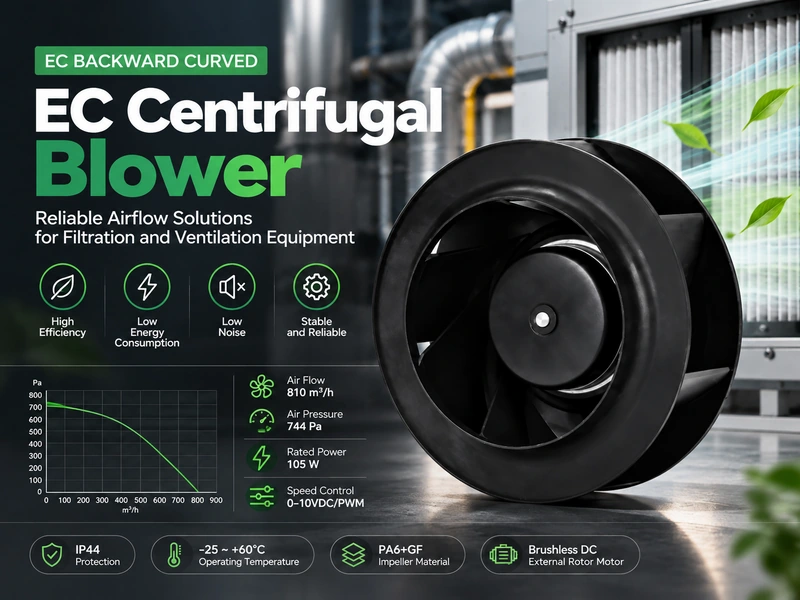
The EC140 single-inlet EC centrifugal blower is designed for controlled airflow in ventilation, air-handling, heating, and equipment cooling systems.
Manufactured by Ningbo E-POWER Energy Saving Technology Co., Ltd., the EC140 combines a galvanized steel impeller with a brushless DC external-rotor motor and electronic speed control.
With a 110W rated power and 480 m³/h catalog airflow, this model provides an option for OEM manufacturers requiring greater airflow capacity than smaller centrifugal blower configurations.
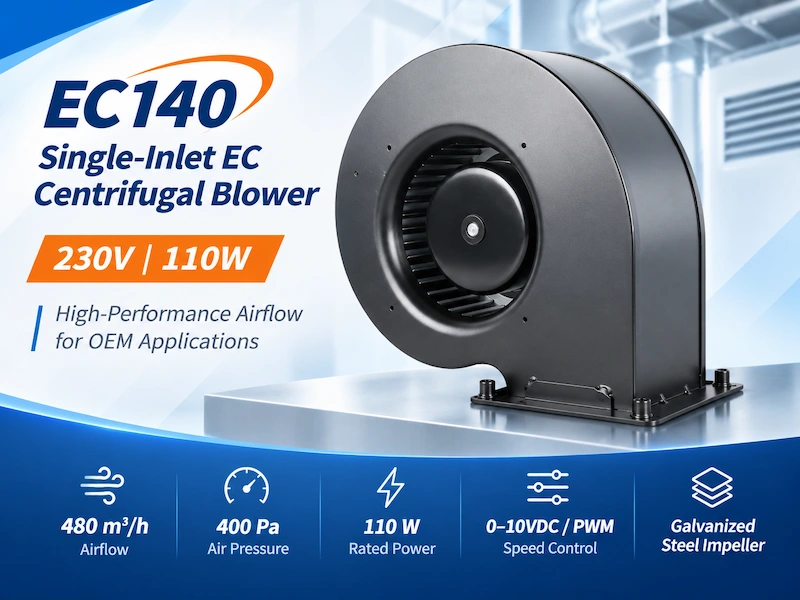
Key Features of the EC140 Centrifugal Blower
The EC140 combines several design characteristics for equipment integration:
-
Single-inlet structure: Supports integration into compatible equipment airflow channels.
-
Galvanized steel impeller: Provides metallic impeller construction.
-
Brushless EC motor: Supports electronically adjustable motor operation.
-
0–10VDC/PWM control: Enables speed adjustment through compatible equipment controllers.
-
IP44 protection: Provides a defined level of protection against solid objects and splashing water.
These features help OEM engineers evaluate mechanical compatibility, airflow requirements, and electrical integration.
EC140 Technical Specifications
The EC140 single-inlet EC centrifugal blower offers the following published specifications:
| Parameter | Specification |
|---|---|
| Part Number | DGF2E140A2 |
| Rated Voltage | 230 VAC |
| Frequency | 50/60 Hz |
| Rated Power | 110 W |
| Rated Current | 0.9 A |
| Rated Speed | 2,150 RPM |
| Airflow | 480 m³/h |
| Air Pressure | 400 Pa |
| Noise Level | 65 dBA |
| Operating Ambient Temperature | -25°C to +60°C |
| Impeller Material | Galvanized Steel Sheet |
| Motor Type | Brushless DC External Rotor |
| Protection Rating | IP44 |
| Insulation Class | B |
| Speed Control | 0–10VDC / PWM |
| Net Weight | 2.3 kg |
Catalog airflow and pressure ratings should not be interpreted as simultaneous operating-point values.
EC140 vs. EC133: Which Model Should You Choose?
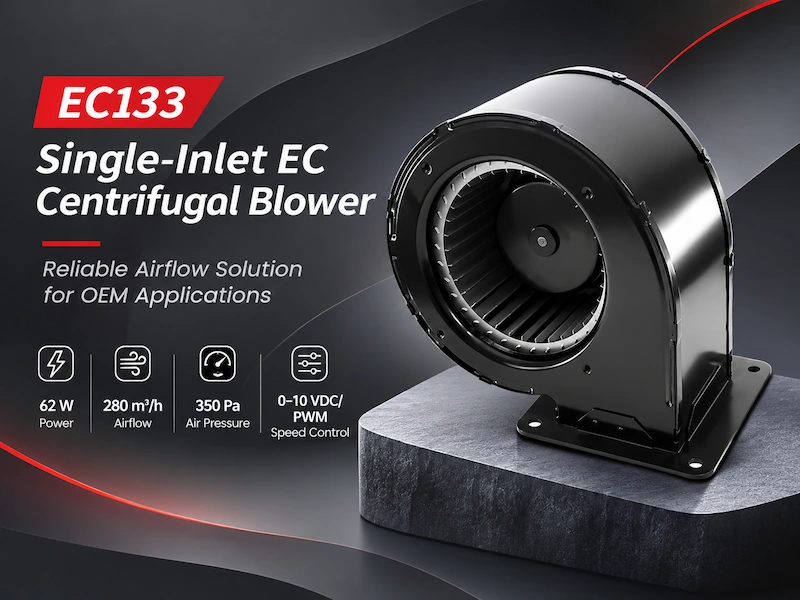
Compared with the EC133 single-inlet centrifugal blower, the EC140 offers higher published airflow and pressure ratings.
| Specification | EC133 | EC140 |
|---|---|---|
| Rated Power | 62 W | 110 W |
| Airflow | 280 m³/h | 480 m³/h |
| Air Pressure | 350 Pa | 400 Pa |
| Net Weight | 1.5 kg | 2.3 kg |
The EC140 is worth evaluating when equipment requires greater airflow capacity. However, engineers should confirm the actual duty point, installation space, and power requirements before selecting either model.
Common OEM Applications
The EC140 single-inlet EC centrifugal blower can be evaluated for:
Ventilation Equipment: Controlled airflow through compatible ventilation channels.
Air-Handling Systems: Air delivery in HVAC and industrial air-processing equipment.
Equipment Cooling: Air circulation for machinery and electrical assemblies.
Heating Equipment: Controlled airflow for compatible heating systems.
Actual suitability depends on system resistance, environmental conditions, and equipment-level validation.
OEM Integration and Purchasing Support
E-POWER integrates motor development, electronic control engineering, blower manufacturing, and performance testing to support OEM equipment projects.
Before requesting a quotation, buyers should prepare their target airflow, operating pressure, supply voltage, control signals, mounting requirements, and estimated annual purchasing volume.
Providing these details helps the engineering team assess product compatibility and discuss suitable configurations before sample evaluation.
Review the EC140 Product Details or explore the E-POWER Technical Catalog for additional product information.
Conclusion
The EC140 single-inlet EC centrifugal blower combines 110W rated power, a galvanized steel impeller, and electronic speed control for OEM ventilation and air-handling equipment.
Its published airflow and pressure specifications provide a useful starting point for equipment manufacturers evaluating centrifugal blower solutions.
Looking for a centrifugal blower for your next OEM project? Contact E-POWER to request technical drawings, discuss sample requirements, customization feasibility, and obtain a quotation for your purchasing needs.