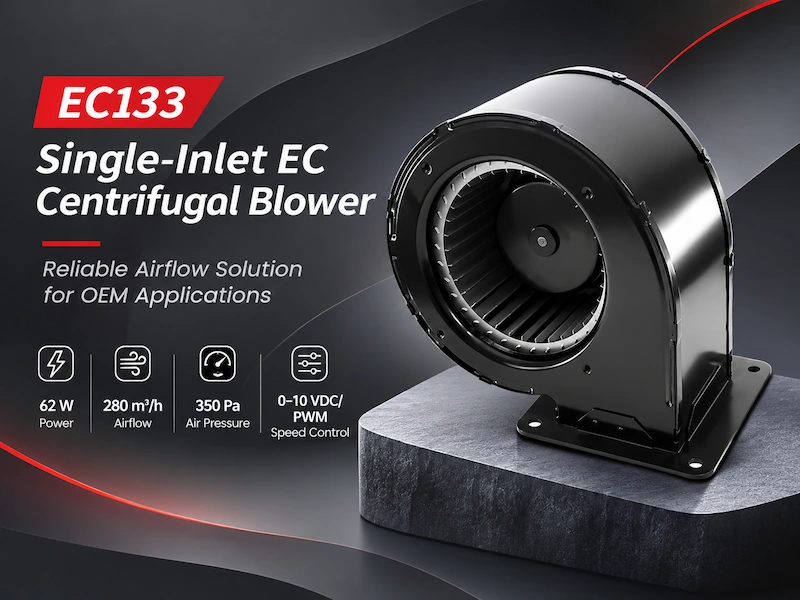
The EC133 single-inlet EC centrifugal blower is designed for controlled airflow in ventilation, air-handling, heating, and equipment cooling systems.
Manufactured by Ningbo E-POWER Energy Saving Technology Co., Ltd., this model combines a galvanized steel impeller with a brushless DC external-rotor motor and electronic speed control.
With a 230VAC input and 62W rated power, the EC133 provides an airflow solution for OEM manufacturers requiring compact centrifugal equipment integration.
What Makes the EC133 Different?
The EC133 features a single-inlet centrifugal configuration with a galvanized steel sheet impeller.
Its brushless external-rotor motor supports electronically controlled operation, while the 0–10VDC/PWM interface enables compatible speed adjustment.
Other published characteristics include IP44 protection, Class B insulation, and an operating ambient temperature range of -25°C to +60°C.
These features provide a technical basis for evaluating equipment compatibility.
EC133 Technical Specifications
The EC133 single-inlet EC centrifugal blower provides the following published specifications:
| Parameter | Specification |
|---|---|
| Part Number | DGF2E133A1 |
| Rated Voltage | 230 VAC |
| Frequency | 50/60 Hz |
| Rated Power | 62 W |
| Rated Current | 0.5 A |
| Rated Speed | 2,300 RPM |
| Airflow | 280 m³/h |
| Air Pressure | 350 Pa |
| Noise Level | 62 dBA |
| Impeller Material | Galvanized Steel Sheet |
| Motor Type | Brushless DC External Rotor |
| Protection Rating | IP44 |
| Insulation Class | B |
| Speed Control | 0–10VDC / PWM |
| Net Weight | 1.5 kg |
Published airflow and pressure ratings should be evaluated against the complete performance curve rather than assumed to occur simultaneously.
Galvanized Steel Impeller and Airflow Performance
The EC133 uses a galvanized steel sheet impeller for centrifugal air delivery.
Metal impeller construction provides specific mechanical characteristics, while the blower configuration supports airflow against system resistance.
OEM engineers should review the performance curve to verify whether the fan meets the required operating point.
Actual airflow depends on the connected equipment, duct resistance, and installation conditions.
Electronic Speed Control and Installation
The EC133 single-inlet EC centrifugal blower supports 0–10VDC and PWM speed-control interfaces.
These options allow compatible equipment controllers to adjust blower operation according to application requirements.
Before installation, engineers should verify signal compatibility, electrical connections, mounting dimensions, and available installation space.
The product's dimensional drawings and performance information support OEM equipment planning.
Common OEM Applications
The EC133 can be evaluated for several equipment applications.
Ventilation Equipment: Controlled air movement in compatible ventilation assemblies.
Air-Handling Systems: Airflow delivery through appropriately designed equipment channels.
Heating Equipment: Air circulation for applications requiring defined operating performance.
Equipment Cooling: Airflow support for industrial machinery and electronic equipment.
Final suitability must be verified through system-level testing.
OEM Integration and Quality Assurance
E-POWER provides motor engineering, electronic control development, blower manufacturing, and product testing capabilities.
OEM cooperation includes airflow matching, electrical-interface evaluation, installation review, and sample testing.
Buyers should provide required airflow, pressure, voltage, control signals, mounting drawings, and estimated purchasing quantities.
Review the EC133 Product Details or contact E-POWER for technical information and OEM quotations.
Conclusion
The EC133 single-inlet EC centrifugal blower combines a 62W motor, galvanized steel impeller, and electronic speed-control capabilities for industrial airflow applications.
Its published specifications help OEM engineers evaluate performance, electrical compatibility, and installation requirements.
Contact E-POWER to discuss EC133 technical specifications, OEM integration, and bulk purchasing requirements.