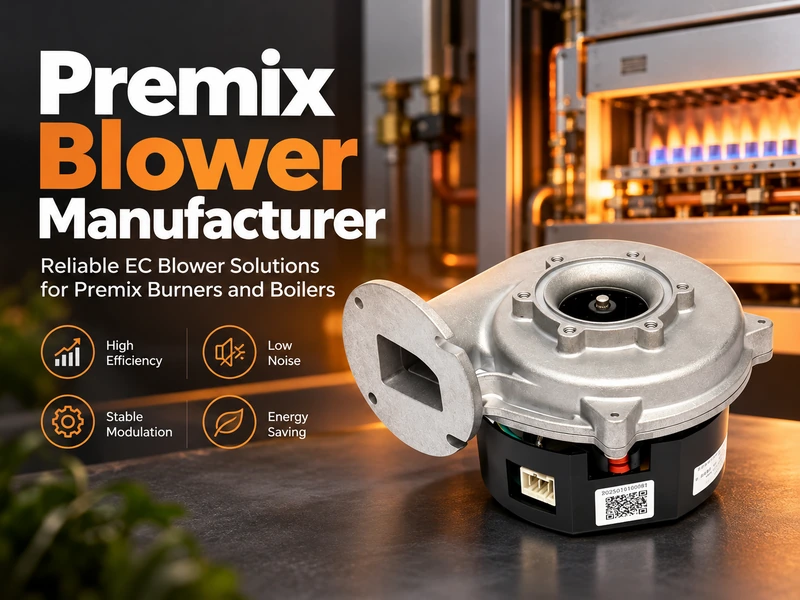
Choosing a reliable premix blower manufacturer is essential for OEMs developing condensing boilers, premixed gas burners, and industrial heating equipment.
Unlike general ventilation fans, premix combustion blowers operate within an interconnected combustion system. Their airflow and pressure characteristics must work with the Venturi mixer, gas valve, burner, heat exchanger, and electronic controller.
The correct premix blower must deliver sufficient airflow against system resistance, respond accurately to modulation commands, and support stable operation throughout the burner's required heating range.
Ningbo E-POWER Energy Saving Technology Co., Ltd. manufactures EC gas blowers and provides engineering support for combustion-air applications. Its EC gas blower range includes multiple D-RG series models designed for different airflow, pressure, and OEM integration requirements.
This guide explains how equipment manufacturers can evaluate premix blower performance, select suitable models, validate system compatibility, and reduce technical risks before production.
What Is a Premix Blower and How Does It Work?
A premix blower is an air-moving component used in a combustion system that mixes fuel gas and air before the mixture reaches the burner.
It is commonly applied in fully premixed gas boilers, commercial heating equipment, and premix burner systems.
A typical system includes:
-
An EC combustion blower supplying controlled airflow.
-
A gas valve regulating fuel delivery.
-
A Venturi mixer or premixing assembly.
-
A burner surface where combustion occurs.
-
An electronic controller coordinating heat demand and system operation.
In a typical arrangement, the controller requests a heating output, and the blower responds by adjusting its rotational speed.
The gas valve and premixing arrangement must then provide the appropriate fuel delivery for the operating condition.
The premixed gas-air stream reaches the burner, where combustion occurs under controlled conditions.
The blower itself does not determine combustion efficiency, emissions, or flame stability. These depend on the coordinated behavior of the entire system.
A professional premix blower manufacturer should therefore evaluate blower specifications together with the connected combustion components.
For additional application information, explore E-POWER's Gas Burner Systems Solutions.
Which OEM Applications Require Premix Combustion Blowers?
Premix blowers are used in equipment that requires controlled combustion-air delivery and variable heating output.
| OEM Application | Main Technical Requirement | Typical Engineering Challenge |
|---|---|---|
| Residential condensing boilers | Compact blower with adjustable airflow | Low-load stability and installation space |
| Commercial gas boilers | Controlled airflow over varying heating loads | System resistance and extended operation |
| Industrial premix burners | Application-specific airflow and pressure | Burner matching and operating range |
| Metal-fiber burner systems | Stable airflow through the burner assembly | Burner-surface pressure loss |
| Gas-fired steam generators | Responsive combustion-air supply | Changing thermal demand |
| Commercial gas cooking equipment | Airflow compatible with burner controls | Frequent load changes and operating conditions |
Each application has different airflow resistance, temperature, operating duration, and control requirements.
For example, a residential wall-hung boiler may prioritize compact dimensions and low operating noise, while a commercial burner manufacturer may focus on pressure capability, modulation behavior, and production consistency.
Consequently, selecting a blower solely by the burner's nominal heating capacity is insufficient.
How Do Airflow and Static Pressure Determine Premix Blower Selection?
Airflow and static pressure are two critical engineering parameters.
Airflow, normally expressed in m³/h, indicates the volume of air supplied by the blower.
Static pressure, expressed in Pa, indicates the pressure developed by the blower against system resistance.
In a premixed combustion system, resistance can be influenced by the air inlet, Venturi mixer, burner assembly, heat exchanger, and flue configuration.
A blower's maximum airflow and maximum static pressure are measured at different points on its performance curve.
They should not be interpreted as simultaneous operating values.
Essential Blower Selection Parameters
| Parameter | What OEM Engineers Should Verify |
|---|---|
| Required airflow | Air demand at minimum, rated, and maximum heating loads |
| Static pressure | Total system resistance at relevant operating points |
| Performance curve | Whether the blower can satisfy the required duty points |
| Rated voltage | Compatibility with the appliance power supply |
| Motor speed | Operating range and required modulation capability |
| Control signal | PWM characteristics, feedback, and controller compatibility |
| Installation dimensions | Mounting, inlet, outlet, and connector requirements |
| Operating environment | Temperature, moisture, vibration, and duty cycle |
Actual blower selection should use the intersection of the blower performance curve and the equipment's system resistance curve.
Engineering teams may refer to ISO 5801:2017, including its 2025 amendment, or ANSI/AMCA 210-25 / ASHRAE 51-25 when reviewing standardized fan aerodynamic testing methods. These references do not establish that an individual blower is certified under those standards.
For a reliable selection, buyers should request complete model-specific performance data rather than relying on headline specifications.
Why Is Venturi Mixer Compatibility Important?
The Venturi mixer plays an important role in many premixed combustion systems.
It creates a pressure relationship that enables fuel gas to mix with the incoming combustion air according to the gas-valve and premixer design.
However, Venturi geometry and pressure losses vary between combustion systems.
A blower compatible with one premixer may not provide the required performance with another.
Three Factors Affecting Matching
1. Venturi Pressure Loss
The Venturi arrangement introduces resistance that must be considered when selecting the blower.
A blower with sufficient free-air capacity may still fail to provide the required airflow after connection to the complete combustion system.
2. Gas-Valve Response
The gas valve must respond appropriately to the control and pressure conditions established by the system.
The relationship between blower operation and gas delivery should be evaluated across the intended heating range.
3. Burner Characteristics
Different burner surfaces, including metal-fiber and other premix designs, may have different pressure-loss characteristics and combustion requirements.
These differences influence the complete system's operating behavior.
For OEM development, the correct approach is to evaluate the blower, Venturi, gas valve, burner, and controller as a coordinated assembly.
Final combustion adjustments and validation must be performed by qualified personnel.
E-POWER Premix Blower Models: Technical Comparison
As an EC blower manufacturer, E-POWER provides several D-RG series products that can be evaluated for premixed combustion applications.
The following values are based on published E-POWER product specifications.
| Model | Rated Voltage | Catalog Airflow | Max. Static Pressure | Power Input |
|---|---|---|---|---|
| D-RG77 | 100–120 / 220–230 VAC | 87 m³/h | 2,350 Pa | 60 W ±10% |
| D-RG118 | 220–230 VAC | 100 m³/h | 3,800 Pa | 73 W ±10% |
| D-RG148 | 100–120 / 220–230 VAC | 220 m³/h | 4,100 Pa | 210 W ±10% |
| D-RG138 | 100–120 / 220–230 VAC | 310 m³/h | 5,000 Pa | 300 W ±10% |
Note: Published airflow and maximum static-pressure figures represent different operating conditions. Confirm the latest model specifications, airflow-pressure curve, and electrical configuration before selecting a blower.
Which Model Fits Different OEM Requirements?
D-RG77: A compact EC blower platform that can be evaluated for smaller combustion systems and space-restricted heating equipment.
D-RG118: Offers greater published maximum static pressure than D-RG77 and may be considered where the application has different system-resistance requirements.
D-RG148: Provides an intermediate airflow range for OEM projects requiring a different combination of airflow and pressure performance.
D-RG138: Offers higher published airflow and maximum pressure capability for applications with greater combustion-air requirements.
These are preliminary selection directions, not guarantees of burner compatibility.
The final choice must consider the complete performance curve, modulation behavior, installation requirements, and combustion validation results.
Buyers can review further product information through the E-POWER Technical Catalog.
How Does EC Motor Control Affect Burner Modulation?
Modern premix burners frequently require adjustable heating output.
EC motor technology allows blower speed to be controlled electronically, making it suitable for applications requiring variable airflow.
However, proper modulation depends on the compatibility of the blower electronics and burner controller.
Important Control Requirements
| Control Feature | Engineering Consideration |
|---|---|
| PWM input | Signal level, frequency, and duty-cycle mapping |
| Speed feedback | Feedback format and controller interpretation |
| Startup response | Behavior during the approved startup sequence |
| Minimum speed | Stable operation within the required low-load range |
| Maximum speed | Performance at maximum heating demand |
| Transient response | Behavior when heating demand changes |
| Fault signaling | Detection and handling of abnormal operation |
Two EC blowers may have similar aerodynamic specifications but different electronic characteristics.
A physically compatible connector does not necessarily mean the control signals are interchangeable.
Before approval, the OEM should verify the electrical interface, controller response, and required safety functions.
Stable burner modulation must be demonstrated through complete-system testing rather than inferred from the blower's speed range alone.
What Materials and Manufacturing Features Matter?
A premix combustion blower typically includes an impeller, motor, housing, bearings, and electronic control components.
These elements influence performance, durability, and manufacturing consistency.
Impeller Materials
Plastic impellers can support lightweight and compact designs, while metal impellers offer different mechanical and thermal characteristics.
Material suitability depends on the actual operating conditions and validated blower design.
For example, E-POWER also offers the D-RG138T with a metal impeller.
Changing impeller material can influence inertia, vibration, balancing requirements, and mechanical performance.
Therefore, material selection should be evaluated as part of the complete blower design.
Precision Manufacturing
Important manufacturing activities include motor winding, rotor assembly, impeller balancing, electronic-component inspection, and final performance verification.
Consistent manufacturing helps minimize product variation between samples and production batches.
For long-term OEM projects, manufacturing repeatability is particularly important because combustion controls depend on predictable component behavior.
How Should OEMs Validate a Premix Blower Before Production?
A reliable premix blower manufacturer should support engineering verification before large-volume purchasing.
OEMs should organize validation around the required operating conditions.
| Validation Stage | Main Evaluation Objective |
|---|---|
| Documentation review | Confirm specifications, drawings, and electrical interfaces |
| Preliminary performance testing | Verify airflow and pressure at intended duty points |
| Startup evaluation | Confirm appropriate blower response during startup |
| Low-load operation | Evaluate minimum modulation conditions |
| Rated and maximum load | Verify performance under required operating conditions |
| Load transitions | Check system response during changes in heat demand |
| Reliability evaluation | Assess noise, vibration, temperature, and operating consistency |
| Production approval | Establish approved specifications and acceptance criteria |
A successful component-level test does not automatically qualify the completed burner or boiler.
The appliance manufacturer remains responsible for applicable combustion testing, safety validation, and regulatory requirements.
This is particularly important when introducing a different blower, gas valve, premixer, or control system into an existing approved appliance.
What Quality Control Should a Premix Blower Manufacturer Provide?
OEM buyers need confidence that production units will perform consistently with approved samples.
E-POWER's published manufacturing capabilities cover motor and electronic control development, precision assembly, incoming component inspection, dynamic balancing, performance testing, and reliability evaluation.
Its quality-control approach includes inspection during incoming material handling, manufacturing, and finished-product testing.
For supplier qualification, buyers should request appropriate documentation, such as approved drawings, model specifications, test results, inspection requirements, and product-revision information.
E-POWER also publishes ISO 9001 quality-management certification information.
However, quality-management certification should not be confused with approval of a complete gas combustion appliance.
OEMs must verify which certification and compliance documents apply to the particular product configuration and destination market.
What Are the Costs and Risks of Choosing the Wrong Blower?
The purchasing price is only one part of the total project cost.
An unsuitable blower may create additional expenses through redesign, prototype testing, electrical changes, control-system modifications, or product revalidation.
| Procurement Risk | Potential Consequence | Recommended Action |
|---|---|---|
| Incorrect duty point | Insufficient combustion-air performance | Review full performance curves |
| Incompatible control | Startup or modulation problems | Verify PWM and feedback requirements |
| Mechanical mismatch | Installation modifications | Review dimensional drawings |
| Inadequate validation | Delayed equipment approval | Establish a test plan early |
| Manufacturing variation | Inconsistent product performance | Confirm inspection and change controls |
| Poor supplier communication | Delayed engineering decisions | Agree on technical responsibilities |
A lower component quotation may not produce a lower total project cost if substantial engineering changes are required.
Supplier selection should therefore balance technical suitability, quality consistency, engineering support, and commercial terms.
Why Work with E-POWER for OEM Premix Blower Projects?
Ningbo E-POWER Energy Saving Technology Co., Ltd. combines EC blower engineering, motor development, electronic control expertise, manufacturing, and testing capabilities.
The company supports OEM and ODM projects involving blower selection, airflow matching, electrical interface assessment, sample development, and production coordination.
Typical OEM Cooperation Process
| Stage | Engineering and Procurement Activity |
|---|---|
| 1. Requirement review | Evaluate burner type, airflow, pressure, and load range |
| 2. Product selection | Identify candidate D-RG blower configurations |
| 3. Technical matching | Review control signals, Venturi arrangement, and installation |
| 4. Sample evaluation | Verify blower and system performance |
| 5. Product approval | Confirm specifications and quality requirements |
| 6. Volume supply | Coordinate approved production and delivery arrangements |
Available customization may involve motor parameters, electrical connections, control interfaces, and mechanical design.
The feasibility, minimum order quantity, development cost, and delivery schedule must be confirmed for each project.
For OEM customers developing new heating or combustion equipment, working with a manufacturer that understands the relationship between airflow, motor control, and system integration can simplify technical communication.
What Information Should You Send for a Premix Blower Quotation?
Before contacting a premix blower manufacturer, prepare the key technical requirements.
| Required Information | Details to Provide |
|---|---|
| Equipment application | Residential boiler, commercial burner, or industrial heating |
| Heating load | Minimum, rated, and maximum operating requirements |
| Airflow and pressure | Required duty points and known system resistance |
| Fuel and mixing system | Fuel type, gas valve, Venturi, and burner details |
| Electrical supply | Voltage and frequency |
| Control requirements | PWM signal, feedback, and controller interface |
| Mechanical dimensions | Installation drawings and connection details |
| Operating conditions | Temperature, humidity, and duty cycle |
| Purchasing requirements | Estimated annual quantity and project schedule |
Providing this information helps the engineering team evaluate relevant blower options and identify additional validation requirements.
Need an EC premix blower for your OEM combustion system?
Explore the E-POWER Gas Blower Product Range or contact E-POWER with your target airflow, static pressure, control requirements, and estimated annual demand.
The team can discuss suitable D-RG series options and the technical information needed for application matching.
Frequently Asked Questions
1. What does a premix blower manufacturer produce?
A premix blower manufacturer develops and supplies blowers used to deliver combustion air in premixed burner systems. Depending on its capabilities, it may also provide motor, electronic control, and OEM integration support.
2. What is the difference between a premix blower and a regular ventilation fan?
A premix blower is selected for controlled airflow within a combustion system, often requiring specific pressure characteristics, variable-speed response, and compatible control interfaces. General ventilation fans are not automatically suitable for these requirements.
3. Can an EC blower be used with a Venturi gas mixer?
Yes, if its aerodynamic performance and control response are compatible with the Venturi, gas valve, burner, and complete equipment requirements. The combination must be validated through appropriate system testing.
4. How do I select the correct airflow for a premix burner?
Determine the combustion system's required operating conditions and airflow-pressure duty points at relevant loads. Use the blower performance curve and system resistance information to evaluate candidate models.
5. Are D-RG77 and D-RG118 suitable for premix boilers?
Both are EC combustion blower models that can be evaluated for heating applications. Suitability depends on the specific boiler's pressure losses, control requirements, mounting arrangement, and validation results.
6. What is PWM control in a premix combustion blower?
PWM stands for pulse-width modulation. It can be used to command blower speed electronically. Signal characteristics, response mapping, and feedback must match the approved control system.
7. Can a premix blower guarantee low NOx emissions?
No. NOx emissions depend on the complete combustion system, including the burner, gas-air mixing, fuel conditions, heat exchanger, and controls. The completed equipment must undergo appropriate emissions testing.
8. What OEM customization options are available?
Depending on engineering feasibility, customization may involve airflow performance, motor settings, electrical interfaces, connectors, mounting arrangements, and control compatibility. Scope and costs require project-specific confirmation.
9. What quality documents should OEM buyers request?
Buyers should request relevant technical specifications, approved drawings, performance data, quality-control information, applicable certifications, and documentation identifying the supplied product configuration.
10. How can I request a quotation from E-POWER?
Submit the equipment application, required airflow and static pressure, heating-load range, electrical and control requirements, installation drawings, and estimated order quantity through the E-POWER Contact Page.
Conclusion
Choosing the right premix blower manufacturer requires more than comparing airflow ratings, motor power, or purchasing prices.
For boiler and burner OEMs, the most important considerations are airflow-pressure matching, Venturi compatibility, gas-valve coordination, electronic modulation, mechanical integration, and verified manufacturing consistency.
A suitable EC blower must perform across the required heating range and be validated as part of the complete combustion system.
E-POWER provides EC combustion blower solutions, including the D-RG77, D-RG118, D-RG148, and D-RG138, supported by motor engineering, electronic control development, manufacturing, and OEM application assistance.
Explore E-POWER's EC Gas Blowers and request an OEM technical consultation to discuss your premix burner specifications, operating conditions, and customized blower requirements.