
Selecting a reliable gas boiler blower supplier is essential for boiler manufacturers seeking alternative sourcing, stable production, or improved component compatibility.
A combustion blower controls air delivery to the burner and interacts with the gas valve, Venturi mixer, heat exchanger, and electronic controller. Replacing it without proper validation can affect combustion performance, noise, electrical compatibility, and equipment safety.
For boiler OEMs, successful supplier qualification depends on three factors: matching actual airflow-pressure requirements, verifying system compatibility, and confirming repeatable manufacturing quality.
Ningbo E-POWER Energy Saving Technology Co., Ltd. manufactures EC combustion blowers and supports OEM equipment manufacturers with product selection, technical matching, sample evaluation, and manufacturing coordination.
This guide explains how to evaluate alternative suppliers and qualify suitable blowers for residential and commercial boiler applications.
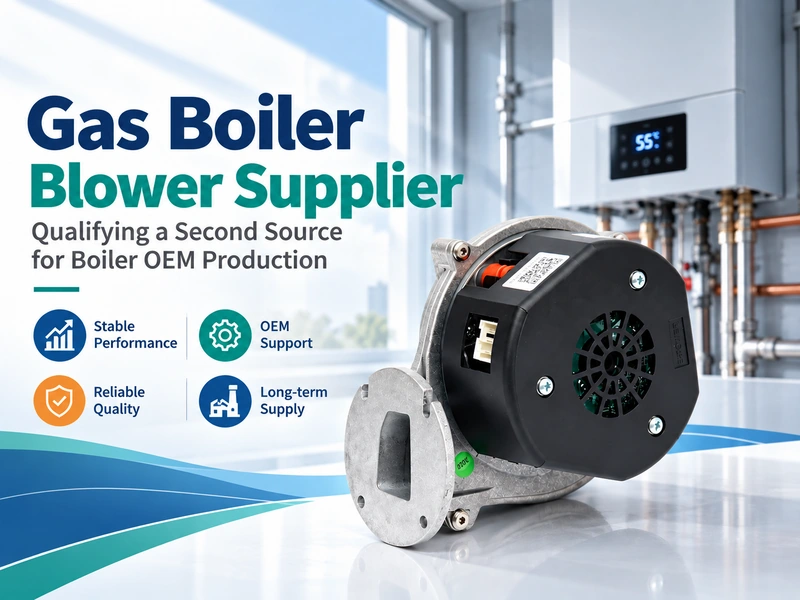
Why Do Boiler Manufacturers Need a Second Gas Boiler Blower Supplier?
Depending on one component supplier can create purchasing and production risks.
Common challenges include component discontinuation, increasing prices, delivery delays, limited manufacturing capacity, and inconsistent product quality.
A qualified second supplier can improve sourcing flexibility and reduce dependency on a single manufacturer.
However, selecting an alternative combustion blower is not simply a purchasing decision.
Even products with similar dimensions and maximum airflow specifications may perform differently under real boiler operating conditions.
A suitable supplier must demonstrate technical compatibility and provide sufficient documentation for engineering validation.
For OEM procurement teams, the objective should be long-term supply reliability without compromising the approved boiler design.
What Should OEM Buyers Check Before Selecting a Supplier?
A professional gas boiler blower supplier should be evaluated through technical specifications, manufacturing capability, and application support.
| Evaluation Factor | Key Requirements | Purchasing Importance |
|---|---|---|
| Airflow | Required airflow at actual operating points | Supports combustion-air demand |
| Static Pressure | Pressure capability under system resistance | Helps maintain required airflow |
| Motor Technology | EC motor characteristics and efficiency | Supports variable-speed operation |
| Speed Control | PWM, feedback, and electrical compatibility | Enables integration with boiler controls |
| Mechanical Design | Mounting, housing, inlet, and outlet dimensions | Reduces installation modifications |
| Quality Control | Motor, airflow, vibration, and final inspection | Supports consistent production |
| OEM Support | Engineering review and customization feasibility | Reduces integration risks |
| Supply Reliability | Production planning and change management | Supports long-term procurement |
Buyers should request technical drawings, performance curves, electrical specifications, and relevant quality documentation before approving samples.
How Do Airflow and Static Pressure Affect Boiler Blower Selection?
Airflow and static pressure are two essential parameters in combustion blower selection.
Airflow, typically measured in m³/h, describes the air volume delivered by the blower.
Static pressure, measured in Pa, indicates the blower's ability to operate against airflow resistance.
In condensing boilers, resistance may come from the burner, Venturi arrangement, heat exchanger, air inlet, and flue system.
Importantly, maximum airflow and maximum static pressure are not achieved simultaneously.
The actual blower operating point depends on the intersection of the fan performance curve and the system resistance curve.
OEM engineers should evaluate performance at minimum, rated, and maximum heating loads.
A blower that performs adequately at maximum output may still be unsuitable for ignition or low-load modulation.
For additional application information, explore E-POWER's Residential Heating Solutions.
E-POWER Gas Boiler Blower Models: Technical Comparison
E-POWER offers several EC centrifugal blower models for heating and combustion-air applications.
The following specifications are based on published product information.
| Model | Rated Voltage | Airflow | Maximum Static Pressure | Power Input |
|---|---|---|---|---|
| D-RG77 | 100–120 / 220–230 VAC | 87 m³/h | 2,350 Pa | 60 W ±10% |
| D-RG118 | 220–230 VAC | 100 m³/h | 3,800 Pa | 73 W ±10% |
| D-RG148 | 100–120 / 220–230 VAC | 220 m³/h | 4,100 Pa | 210 W ±10% |
| D-RG138 | 100–120 / 220–230 VAC | 310 m³/h | 5,000 Pa | 300 W ±10% |
Note: Catalog airflow and maximum static pressure represent separate performance conditions. Verify the actual duty point, electrical configuration, and latest specifications before selection.
Which Model Should OEM Buyers Consider?
D-RG77: A compact option for smaller combustion-air systems where installation space is limited.
D-RG118: Offers higher published maximum static pressure than D-RG77 and may be evaluated for different resistance requirements.
D-RG148: Provides an intermediate airflow range for heating equipment requiring different performance and installation characteristics.
D-RG138: Offers higher published airflow and pressure capability for applications with greater air-delivery requirements.
None of these models should be considered interchangeable without engineering verification.
OEM buyers can review additional drawings and specifications through the E-POWER Technical Catalog.
Why Are Electrical Control and Mechanical Compatibility Important?
Modern condensing boilers frequently use electronically commutated motors for variable-speed combustion-air delivery.
However, two EC blowers may use different control interfaces or respond differently to identical commands.
Before approving a replacement, engineers should verify the rated voltage, PWM signal characteristics, speed-feedback requirements, startup response, minimum operating speed, and fault behavior.
Mechanical compatibility is equally important.
Mounting-hole positions, inlet and outlet geometry, connector locations, sealing surfaces, and installation orientation must match the equipment requirements.
Impeller materials should also be reviewed. Plastic and metal designs can differ in rotational inertia, thermal behavior, vibration characteristics, and mechanical loading.
Matching the airflow rating alone does not establish electrical, mechanical, or combustion-system compatibility.
How Should OEMs Qualify a New Gas Boiler Blower Supplier?
A structured qualification process reduces engineering and procurement risks.
Step 1: Technical Documentation Review
Compare the proposed blower with the existing approved component.
Review airflow-pressure curves, electrical ratings, dimensional drawings, control interfaces, and operating requirements.
Identify any differences before ordering samples.
Step 2: Sample and System Validation
Evaluate the proposed blower in a representative boiler prototype.
Testing should cover relevant airflow-pressure conditions, startup behavior, speed control, noise, vibration, and thermal performance.
The appliance manufacturer must also verify combustion stability, safety functions, and applicable compliance requirements.
Step 3: Production Quality Approval
After successful validation, review manufacturing consistency, inspection methods, product identification, and change-control procedures.
Agree on the approved product configuration and acceptance criteria before releasing production orders.
A qualified supplier should support this process with clear technical communication and appropriate documentation.
What Quality Control Should a Gas Boiler Blower Supplier Provide?
Manufacturing consistency is critical for long-term OEM supply.
E-POWER's published company and manufacturing capabilities include motor development, electronic control engineering, blower assembly, dynamic balancing, and performance testing.
Relevant quality-control activities include incoming material inspection, motor performance testing, assembly inspection, airflow verification, noise and vibration testing, and final product inspection.
Buyers should confirm which tests apply to the exact model being purchased.
Quality-management certification should also be distinguished from product-specific approval. A certified management system does not automatically establish compatibility with a particular boiler or compliance of the completed appliance.
What Are the Hidden Costs of Changing Suppliers?
The lowest unit quotation does not always represent the lowest total purchasing cost.
A replacement blower may require additional engineering, connector changes, software adjustments, prototype testing, or appliance revalidation.
Other risks include inconsistent batch quality, undocumented design changes, and supply interruptions.
To reduce these costs, boiler manufacturers should establish clear technical requirements before sample approval.
A reliable gas boiler blower supplier should help buyers identify compatibility concerns early rather than promising direct replacement without supporting evidence.
Why Consider E-POWER for OEM Gas Boiler Blower Projects?
E-POWER combines EC motor technology, blower engineering, electronic control development, and manufacturing support.
Its D-RG product range provides multiple performance and structural options for boiler and combustion-equipment manufacturers.
OEM cooperation may include product screening, electrical and mechanical interface review, application-specific customization assessment, sample development, and production coordination.
Customization scope, sample availability, minimum order quantities, and lead times are determined according to project requirements.
For a technical evaluation or quotation, buyers should provide:
| Required Information | Details |
|---|---|
| Existing blower | Model, specifications, and drawings |
| Application | Residential boiler, commercial boiler, or burner |
| Performance | Required airflow and static pressure |
| Electrical requirements | Voltage, PWM, feedback, and connectors |
| Installation | Mounting dimensions and available space |
| Purchasing | Estimated annual quantity and project schedule |
Looking for a qualified OEM combustion blower supplier?
Explore E-POWER Gas Blowers or contact the E-POWER team with your existing blower specifications and operating requirements to discuss a suitable replacement or customized solution.
Frequently Asked Questions
1. How do I choose a reliable gas boiler blower supplier?
Evaluate the supplier's technical documentation, manufacturing capabilities, quality-control procedures, OEM support, and ability to demonstrate compatibility with your boiler.
2. Can an EC blower replace another manufacturer's combustion blower?
Possibly, but airflow-pressure performance, voltage, speed control, mounting, and appliance-level safety requirements must be verified before approval.
3. What is the most important specification when selecting a boiler blower?
The blower must meet the required airflow and static pressure at the actual operating points. Electrical and mechanical compatibility are equally necessary.
4. Are D-RG77 and D-RG118 interchangeable?
Not automatically. They have different published performance and electrical characteristics. OEM engineers must review their curves, interfaces, and installation requirements.
5. Why is a blower performance curve important?
It shows the relationship between airflow and pressure, helping engineers determine whether a blower can meet the required system operating conditions.
6. Can E-POWER customize gas boiler blowers?
E-POWER supports OEM engineering discussions involving airflow matching, electrical interfaces, motor parameters, and structural requirements. Feasibility depends on the project.
7. Does a replacement blower require boiler-level validation?
Yes, the responsible OEM must determine and complete the necessary appliance-level performance, combustion, safety, and regulatory assessments.
8. What quality documents should buyers request?
Request relevant specifications, drawings, inspection criteria, applicable test data, product revision information, and appropriate quality or compliance records.
9. How can OEMs reduce blower replacement costs?
Screen technical compatibility before purchasing samples, identify engineering differences early, and agree on testing requirements and acceptance criteria.
10. What information is needed for an OEM blower quotation?
Provide the existing model, target airflow and pressure, supply voltage, control requirements, mounting drawings, operating environment, and estimated order quantity.
Conclusion
Selecting a dependable gas boiler blower supplier requires more than comparing prices or maximum airflow ratings.
For boiler OEMs, the most important factors are actual operating-point performance, electrical compatibility, mechanical integration, manufacturing consistency, and successful system validation.
A properly qualified second source can improve procurement flexibility while reducing the risks associated with supplier dependency.
E-POWER provides EC combustion blower solutions, including the D-RG77, D-RG118, D-RG148, and D-RG138, together with OEM engineering and manufacturing support.
Explore the E-POWER Product Range and request a technical quotation to discuss your boiler application, blower specifications, and second-source requirements.