What buyers actually need from a power tools manufacturer today
When engineers or sourcing teams search for a power tools manufacturer, they are usually not just looking for a logo on a box. They are trying to solve a production problem: which supplier can build a tool or control accessory that holds up in daily use, fits the application, and does not create avoidable service issues later. That question matters even more when the product is not a flashy handheld drill, but a practical electrical control accessory such as a fan speed controller for ventilation equipment.
At first glance, a compact inline controller can seem simple. A rotary dial, a switch, a cord, a molded housing. Yet those plain parts carry a lot of responsibility. The unit has to manage power safely, survive repeated operation, and give the end user a control feel that is predictable rather than vague. For buyers evaluating an OEM power tools manufacturer or any related industrial supplier, this is where details matter. Not every supplier that can mold a plastic shell and assemble wires can also deliver a dependable finished control device.
Why this type of control accessory deserves the same sourcing discipline as a tool
In manufacturing, people sometimes separate “tools” from “accessories” too sharply. In reality, the line is blurry. A fan speed controller used in HVAC systems, air purification equipment, food-processing machinery, or similar installations becomes part of the working environment. If it fails, airflow changes, equipment runs outside the intended condition, and operators notice immediately. That is a production and maintenance issue, not a minor inconvenience.
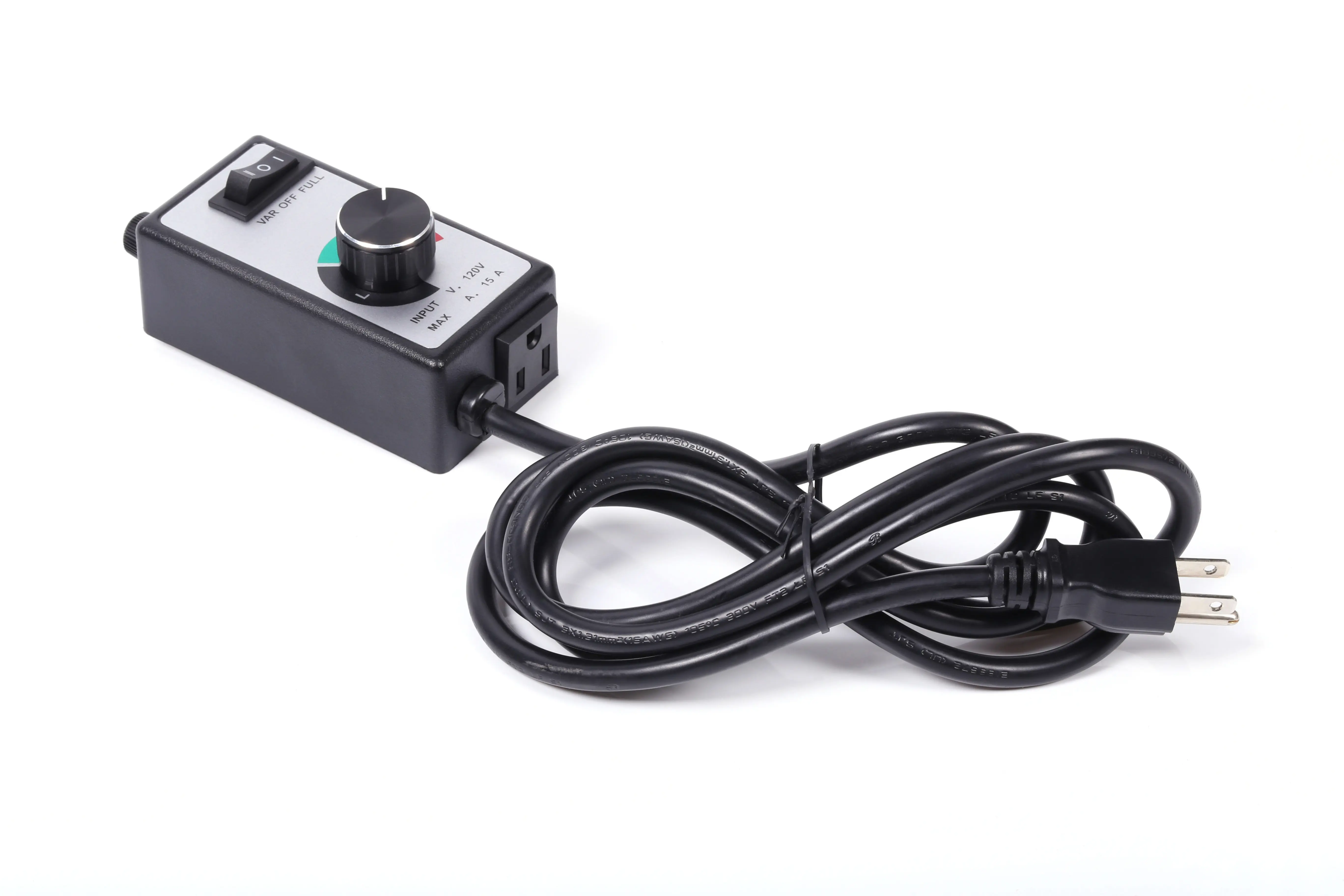
The visible product here is a plug-in inline controller with a rotary knob and a rocker-style OFF / FULL / VAR selector. That tells a buyer a few useful things. First, the unit is meant for manual adjustment, not automation. Second, the enclosure is compact and portable, so installation likely stays simple. Third, the front labeling suggests a straightforward control interface that should be easy for operators to understand without training. Those are small points, but in a plant or equipment integration setting, small points often decide whether users actually adopt the product or bypass it.
Quick reference: what the visible design tells you
Before a buyer asks for samples or a spec sheet, it helps to read the physical product correctly.
The unit appears to use a molded black plastic housing with a semi-matte finish. The control face includes a rotary dial on top and a separate switch with positions that appear to be OFF, FULL, and VAR. A mains cord with a two-prong plug is attached, and another outlet or terminal opening appears to route the fan connection. The printed marking seems to indicate 120 V input and 15 A maximum, though that should be verified against the actual specification sheet before any purchase or publication.
That combination suggests a simple plug-in fan speed controller assembly rather than a standalone fan and not a precision digital variable drive. It is the kind of device buyers choose when they want manual airflow adjustment without committing to a more complex control panel.
Where the manufacturing value really sits
For a sourcing manager, the interesting part is not the knob. It is the manufacturing stack behind the knob.
The housing is likely made through plastic injection molding, then paired with electrical assembly and wiring. The quality of the enclosure affects fit, strain relief, heat behavior, and how the device feels in the hand. A loose rocker switch or poor label adhesion quickly makes an otherwise functional controller look cheap. Likewise, the cord set, terminals, and internal wiring layout have to be assembled in a way that is consistent from unit to unit. If the controller is intended for repeated field use, that consistency matters more than cosmetic polish.
Internal control method is not visible here, and it should not be guessed at. It could be triac-based, transformer-based, or some other AC fan control approach. Buyers should ask directly, because the control method affects compatibility, heat generation, noise, and the type of fan motor the unit can handle. That is one of those questions that seems technical but saves real money when asked early.
Selection criteria buyers should use before placing an order
Electrical fit
Start with the most basic question: does the controller match the electrical environment it will actually face? Printed markings appear to show 120 V and 15 A max, but these values must be confirmed. Do not build a sourcing decision on a photo alone. Confirm input voltage, current limit, and intended load type. A controller that works on one fan class may be a poor fit for another.
Motor and fan compatibility
Not every fan motor responds the same way to manual speed control. This matters in ventilation, HVAC, and air-moving systems. Ask which fan categories are supported, whether the device is intended for specific AC motor types, and whether performance changes at low speed are acceptable for the end application. A controller that sounds fine on paper can behave poorly under a real load.
Housing and ergonomic quality
Black molded plastic is common for good reasons: it is economical, durable enough for many environments, and easy to package. But buyers should still care about the shape, the knob feel, and the switch action. A soft detent, a loose shaft, or a faceplate that scratches easily can create a quality perception problem even if the electronics work correctly.
Assembly integrity
Because this is a corded electrical accessory, assembly quality is not optional. Ask how the cord is secured, how internal connections are supported, and whether the enclosure design reduces accidental strain on the terminals. These are the details that separate a practical OEM product from a fragile one.
How an OEM power tools manufacturer can add value here
Many buyers search for an OEM power tools manufacturer because they want flexibility: branded housings, application-specific features, and a supplier capable of handling both component manufacture and final assembly. That same capability is useful for control accessories like this one.
An OEM-capable supplier can usually help with enclosure design, label layout, knob style, cord configuration, packaging, and maybe even interface changes for a specific installation. For industrial buyers, that can simplify sourcing. One supplier handles molded parts, wiring, labeling, and final assembly instead of forcing the purchasing team to coordinate separate vendors.
There is a caution, though. OEM flexibility should not be mistaken for engineering depth. A supplier may be very good at copying an existing form factor while being less comfortable discussing load behavior, thermal limits, or application-specific compatibility. A serious buyer should test both the manufacturing side and the application understanding side.
Common mistakes when sourcing a controller like this
The first mistake is overfocusing on appearance. A neat housing and a clean label do not guarantee good electrical behavior.
The second mistake is assuming all fan controllers are interchangeable. They are not. Even when two products look similar, the internal control method and supported load type can differ. That difference can make or break the installation.
The third mistake is ignoring the user environment. A controller used in a food-processing area, for example, may face cleaning routines or splashes that a casual indoor consumer product never sees. If the application is industrial, the buyer should ask the supplier how the product is intended to be used and installed rather than assuming a general-purpose design will be enough.
The fourth mistake is failing to confirm the printed electrical marking. Again, a photo may suggest 120 V and 15 A max, but those details should always be checked against the actual spec sheet, especially if the product will be integrated into a larger system.
Practical advice for engineering and sourcing teams
If you are shortlisting suppliers, ask for three things early: the electrical spec sheet, the internal control description, and a breakdown of the mechanical assembly. That is a sensible minimum. It tells you whether the supplier knows what they are building.
If you are looking for a broader manufacturing partner, ask whether the same factory handles plastic injection molding and electrical assembly in-house or through controlled subcontracting. Either model can work, but the answer affects consistency, traceability, and communication speed. A supplier that can clearly explain the process usually creates fewer surprises later.
For product teams, it also helps to think about the operator experience. Does the rotary control have enough resistance to stay where it is set? Is the switch position obvious at a glance? Is the device portable enough to move between stations? These are ordinary questions, but they define how the product feels in real use.
When a simple manual controller is the right choice
Not every application needs digital controls, remote monitoring, or a complex panel. In many cases, a manual inline controller is the more sensible answer. It is easier to understand, easier to deploy, and often easier to service. For ventilation fans in equipment or facility settings, that can be exactly what the buyer wants: direct control, limited complexity, and fewer failure points.
That said, simplicity works only when the controller is properly matched to the load and built with discipline. A straightforward design still has to meet the basic expectations of industrial buyers: safe wiring, reliable switching, stable housing, and clear labeling. Simplicity is not an excuse for vague specs.
FAQ
Is this controller a standalone fan?
No. Based on the visible structure, it appears to be an inline control accessory for a fan, not a fan itself.
Can I assume the unit is 120 V and 15 A?
No. The printed marking appears to indicate that range, but it should be verified against the actual specification sheet before purchase or publication.
Is the internal control type known?
No. The image does not confirm whether the controller is triac-based, transformer-based, or another AC control type.
What kind of buyer is this best suited for?
It fits buyers who need simple manual speed control for ventilation fans in industrial, equipment, or facility applications, especially where compact plug-in installation is preferred.
Next step for buyers
If you are evaluating a power tools manufacturer or an OEM power tools manufacturer for this kind of product, ask for the spec sheet, wiring details, and application limits before you compare price. The right supplier will not only make the enclosure look clean; it will be able to explain how the controller behaves in service, what it is meant to drive, and where its limits begin. That is the difference between a usable industrial accessory and a unit that looks fine until the first real installation.