The D-RG118C EC gas blower is designed for controlled combustion-air delivery in gas boilers, heating appliances, and industrial burner equipment.
Unlike configurations with integrated control electronics, the D-RG118C uses a separate external control board, allowing OEM engineers to accommodate the motor and control electronics as distinct installation components.
For boiler manufacturers, proper selection requires matching airflow, static pressure, electrical connections, and control-board compatibility.
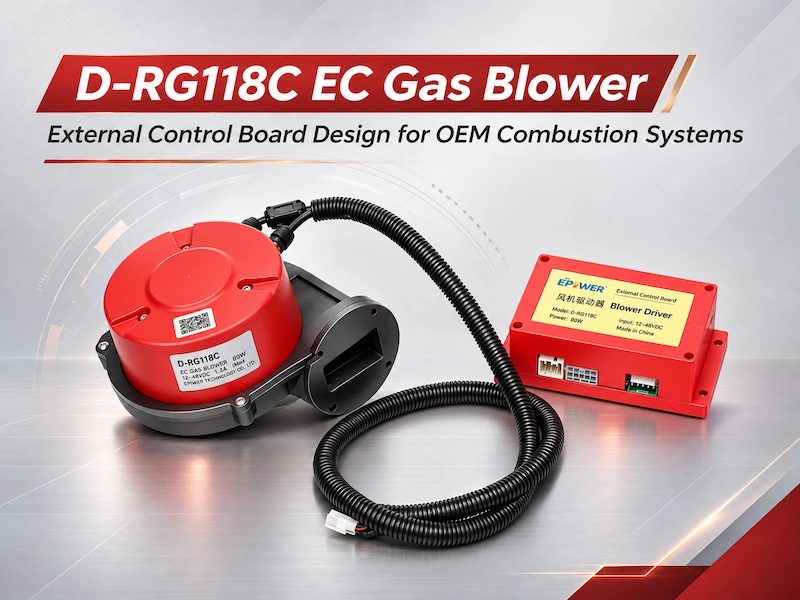
What Makes the D-RG118C Different?
The external control board is the defining feature of this model.
This configuration allows equipment manufacturers to plan board placement separately from the blower housing, according to the approved equipment design.
However, electrical connections, motor commands, control settings, and wiring must match the specified board.
Control functions depend on the matched external board and approved wiring documentation.
D-RG118C Technical Specifications
The D-RG118C EC gas blower provides the following published specifications:
| Parameter | Specification |
|---|---|
| Model | D-RG118C |
| Rated Voltage | 110 / 220 V |
| Frequency | 50/60 Hz |
| Power Input | 80 W |
| Catalog Combustion Power | 40 kW |
| Maximum Speed | 5,800 RPM |
| Airflow | 120 m³/h |
| Maximum Static Pressure | 3,800 Pa |
| Input Current | 0.69 A |
| Impeller Material | Plastic |
| Net Weight | 1.08 kg |
Maximum airflow and static pressure are separate operating-point ratings. The published 200–277 V operating range must also be clarified against the rated-voltage information before ordering.
These specifications help OEM engineers evaluate blower performance and electrical compatibility.
External Control Board and Installation
The D-RG118C uses an EC motor with a separate control board for electronic speed regulation.
Its airflow-pressure performance should be matched to the actual resistance of the connected combustion system.
The manufacturer specifies installation with the shaft horizontal or the motor mounted on top.
Before integration, engineers should verify board placement, connector specifications, mounting requirements, and approved wiring.
Common Applications
The D-RG118C EC gas blower can be evaluated for several applications.
Gas Boilers: Combustion-air delivery for compatible heating systems.
Industrial Heating Equipment: Airflow support for equipment requiring defined pressure performance.
Gas Burner Systems: Integration with appropriate gas valves, burner controls, and mixing components.
Actual suitability requires complete-system validation.
Explore E-POWER Residential Heating Solutions for related applications.
OEM Customization and Quality Assurance
E-POWER provides motor engineering, electronic control development, blower manufacturing, and performance testing.
OEM support includes airflow matching, electrical-interface evaluation, sample testing, and customization assessment.
Quality-control activities include incoming inspection, motor testing, airflow verification, and final product inspection.
Buyers should provide required airflow, static pressure, voltage, external-board requirements, installation drawings, and estimated purchasing volume.
Review the D-RG118C Product Details or contact E-POWER for technical information and OEM quotations.
Conclusion
The D-RG118C EC gas blower combines electronically controlled combustion airflow with a separate external control-board design.
Its specifications provide a starting point for evaluating heating-system compatibility, installation requirements, and OEM integration.
Contact E-POWER to discuss D-RG118C technical documentation, control-board matching, sample evaluation, and bulk purchasing requirements.