
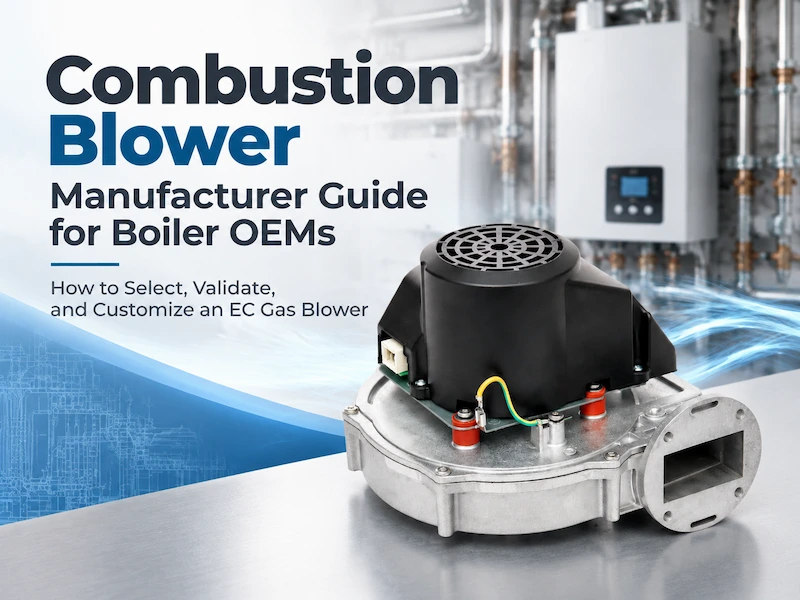
Choosing a combustion blower manufacturer is an important step for boiler, burner, and heating equipment OEMs. A combustion blower must provide the correct airflow and static pressure, respond to the control system, and fit the mechanical structure of the finished appliance.
A standard blower may work for a simple replacement project. However, a new boiler or burner platform often requires a customized solution because each system has different airflow, pressure, control, space, and installation requirements.
A custom combustion blower is designed or adjusted according to the actual operating conditions of the complete equipment.
Why Is a Custom Combustion Blower Needed?
A combustion system normally includes:
- Combustion blower
- Gas valve
- Venturi mixer
- Burner
- Heat exchanger
- Flue system
- Control board
- Safety control system
These components work together as one air-gas control system. If the blower does not match the burner, Venturi, heat exchanger, or flue resistance, the equipment may experience unstable ignition, poor combustion, excessive noise, or insufficient heat output.
For this reason, a combustion blower manufacturer should evaluate the blower as part of the complete system rather than selecting a model only by its maximum airflow.
E-POWER provides combustion blower solutions for residential heating, commercial boilers, industrial heating, gas burner systems, and other applications. Available products include the D-RG77 combustion blower, D-RG118 combustion blower, D-RG138 combustion blower, and D-RG148 EC gas blower.
What Can Be Customized?
Airflow and Static Pressure
Airflow describes how much air the blower can deliver. Static pressure describes the resistance that the blower can overcome.
A boiler may require different airflow and pressure levels during:
- Ignition
- Minimum heat output
- Rated heat output
- Maximum heat output
The selected blower must operate reliably across the complete load range. A product with high free-air volume may not be suitable if it cannot maintain enough pressure after being connected to the burner, heat exchanger, and flue.
When contacting a combustion blower manufacturer, OEM buyers should provide the required airflow and static pressure at the main operating points.
Motor and Speed Control
The motor and control interface can also be customized according to the equipment design.
Common options include:
- Fixed-speed operation
- PWM speed control
- 0-10 V control
- Variable-speed EC motor control
- External controller operation
- Speed feedback
Variable-speed control allows the blower to adjust its output according to the required heat load. Before integration, engineers should confirm the signal type, voltage range, speed range, feedback method, startup response, and stop behavior.
For low-voltage applications, OEM buyers may also review the D-RG118-DC24 and D-RG148-24V-DC.
Mechanical Structure
Mechanical customization helps the blower fit the available installation space.
Typical requirements include:
- Mounting hole position
- Housing dimensions
- Inlet and outlet size
- Airflow direction
- Mounting orientation
- Connector position
- Cable length
- Sealing structure
- Clearance from nearby components
These details are especially important for compact boilers and heating appliances. A suitable mounting design can reduce the need for additional brackets, adapters, or structural changes during assembly.
Electrical Interface
The electrical interface must match the equipment controller and wiring system.
Customization may involve:
- Rated voltage
- Operating frequency
- Connector type
- Wire length
- Rotation direction
- Control signal
- Feedback signal
- Alarm signal
- Grounding arrangement
A connector that fits physically may still be electrically incompatible. The control signal, feedback logic, and operating range must be confirmed before the blower is approved for the appliance.
How Is the Blower Matched to the Complete System?
A custom blower should be evaluated together with the gas valve, Venturi, burner, heat exchanger, and flue.
Changing one component may affect the required blower performance. For example:
- A different burner may create higher pressure loss.
- A different Venturi may require another airflow range.
- A longer flue may increase system resistance.
- A different gas valve may change the air-gas ratio.
- A new controller may require a different speed signal.
This is why a professional combustion blower manufacturer reviews the complete equipment requirements before recommending a model or configuration.
E-POWER Combustion Blower Options
E-POWER offers several D-RG series blowers for different airflow, pressure, power, and installation requirements.
The D-RG77 may be considered for compact residential heating systems and smaller combustion applications.
The D-RG118 can be evaluated for residential boilers and medium combustion systems.
The D-RG138 may be suitable for applications requiring higher airflow and static pressure.
The D-RG148 family can be reviewed for boiler, burner, and hot-water equipment with different power, control, and mounting requirements.
The final model should be selected according to the actual airflow-pressure requirement, control interface, installation dimensions, and operating environment.
What Information Should OEM Buyers Provide?
To start a customization project, provide:
- Equipment type
- Fuel type
- Burner type
- Required heat output
- Minimum, rated, and maximum airflow
- Static pressure at each operating point
- Voltage and frequency
- PWM or 0-10 V requirement
- Speed feedback requirement
- Installation drawing
- Inlet and outlet dimensions
- Operating temperature
- Noise requirements
- Expected operating schedule
Complete information allows the combustion blower manufacturer to determine whether an existing model is suitable or whether a customized configuration is required.
OEM customers can review the E-POWER blower product range, browse the product catalog, or submit project requirements through the E-POWER contact page.
Conclusion
A custom combustion blower is adapted to the real requirements of a specific boiler, burner, or heating system. Customization may include airflow, static pressure, motor type, speed control, electrical interface, mounting structure, dimensions, connectors, and installation orientation.
For OEM buyers, the best approach is to define the complete system requirements before selecting a blower. E-POWER provides D-RG series combustion blowers, including the D-RG77, D-RG118, D-RG138, and D-RG148 for residential heating, commercial boilers, industrial heating, and gas burner applications.
By sharing the required airflow, pressure, voltage, control method, installation dimensions, and operating environment, buyers can work with a combustion blower manufacturer to identify a suitable solution for their equipment. You can also review the complete E-POWER product catalog or contact the E-POWER engineering team for project requirements.