
Patient Warming Systems
Gentle, steady airflow for patient warming systems. E-POWER compact blowers support even heated-air circulation with low noise and flexible integration into medical equipment.
What the blower does
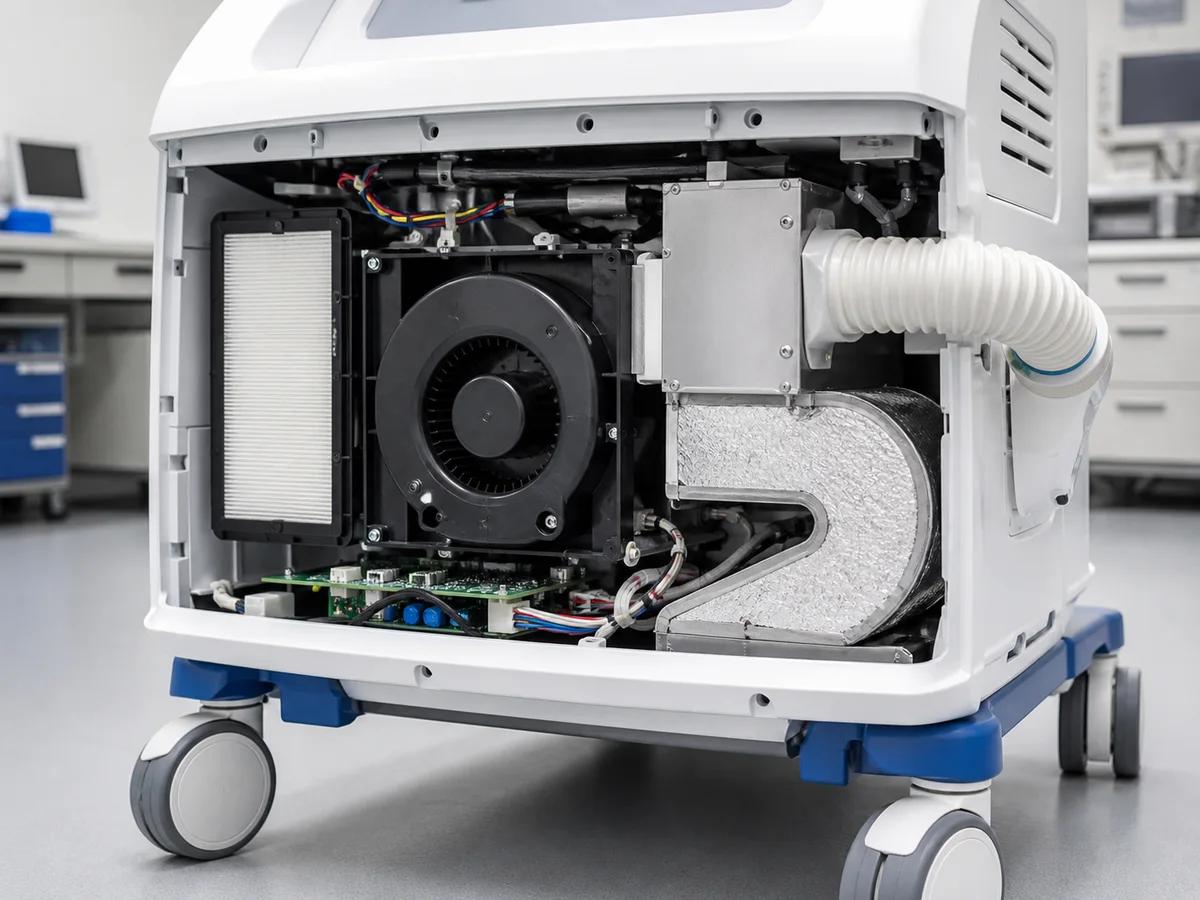
Airflow through the complete system
As the core component of the hot-air circulation system, the blower maintains steady airflow and distributes heated air evenly throughout the warming blanket, helping maintain the patient's body temperature and ensuring comfortable warmth.
- Medical warming blanket
- Patient warming system
- 01
Room air
Air enters through the equipment filter.
- 02
Compact blower
The blower establishes steady circulation.
- 03
Heating element
Air temperature is controlled by the warming unit.
- 04
Blanket channels
Heated air is distributed across the blanket.
Recommended product range
Products for Patient warming
This is an application-level product family, not a medical-certified model claim. Final selection requires the complete airflow path, acoustic target, thermal controls and equipment compliance plan.
Products for this application are being updated. Browse the complete product range or contact our team for selection support.
Bring us the equipment requirement
Send the target operating point and integration constraints. We will help evaluate a suitable blower direction and validation plan.
FAQ
Questions from equipment manufacturers
Do Medical blower and Medical centrifugal fan describe the same component?+
Medical terminology is broad and does not establish device suitability by itself. Medical blower, Medical air blower, Medical fan, Medical centrifugal blower, and Medical centrifugal fan describe possible component categories. Air circulation blower, Heating air blower, Warm air blower, and Forced air blower describe airflow functions, while Compact blower and Mini centrifugal blower emphasize packaging. A candidate still requires review of airflow, pressure, controllability, noise, temperature rise, cleanliness, materials, reliability, electrical interfaces, and fault behavior. Medical use is confirmed only through complete-device engineering, risk management, testing, and applicable regulatory approval.
Can E-Power blowers be evaluated for patient-warming equipment?+
E-Power blowers can be evaluated as components for a Medical warming blanket, Patient warming blanket, Patient warming system, Forced air warming system, or Forced air patient warming system. Related equipment may be described as a Forced air warming blanket, Surgical warming blanket, Operating room warming system, Patient temperature management system, or Patient warming device. These terms describe the finished application, not an automatic certification of the blower. The device manufacturer must validate airflow, heater coordination, temperature uniformity, alarms, noise, filtration, electrical safety, reliability, biocompatibility where relevant, and all applicable regulatory requirements.
What data is required to select a blower for medical warming or temperature management?+
Medical warming projects require the target airflow and pressure across every operating mode, including startup, steady heating, low-flow control, alarm states, and blocked or restricted outlets. E-Power also needs the heater arrangement, air-temperature range, control and feedback signals, power supply, space limits, acoustic target, filtration, cleaning method, duty cycle, and expected environment. A component sample should be evaluated within the complete device. E-Power does not determine the finished device's clinical performance, temperature safety, electrical compliance, reliability classification, or regulatory status.
Does E-Power provide OEM or application-specific blower solutions?+
E-Power supports OEM blower projects and application-specific matching based on technical feasibility, expected volume, and validation requirements. As an OEM blower manufacturer, the company can discuss voltage, control logic, communication functions, wiring, connectors, mounting interfaces, outlet configuration, and supporting components for suitable projects. The process normally begins with requirements review, followed by model screening, drawing and interface confirmation, samples, prototype testing, approval, and controlled production release. Available customization scope, minimum quantity, tooling, validation responsibility, and lead time must be confirmed for each project rather than assumed from a standard model.
What information should I provide for blower selection or a quotation?+
For a useful model recommendation or quotation, provide the equipment type, target airflow and static pressure at minimum, rated, and maximum load, supply voltage and frequency, control signal, speed-feedback requirement, and expected annual quantity. Include installation drawings, inlet and outlet dimensions, connector details, operating temperature, moisture, dust, grease or chemical exposure, noise targets, duty cycle, and any current blower model or curve. Combustion projects should also include available gas-valve, premixer, burner, fuel, gas-pressure, heat-exchanger, and flue information for engineering review.