
Food Machinery Combustion Solutions
Controlled combustion air for commercial gas cooking equipment. E-POWER blowers support efficient premixing, precise heat adjustment and a stable flame across cooking cycles.
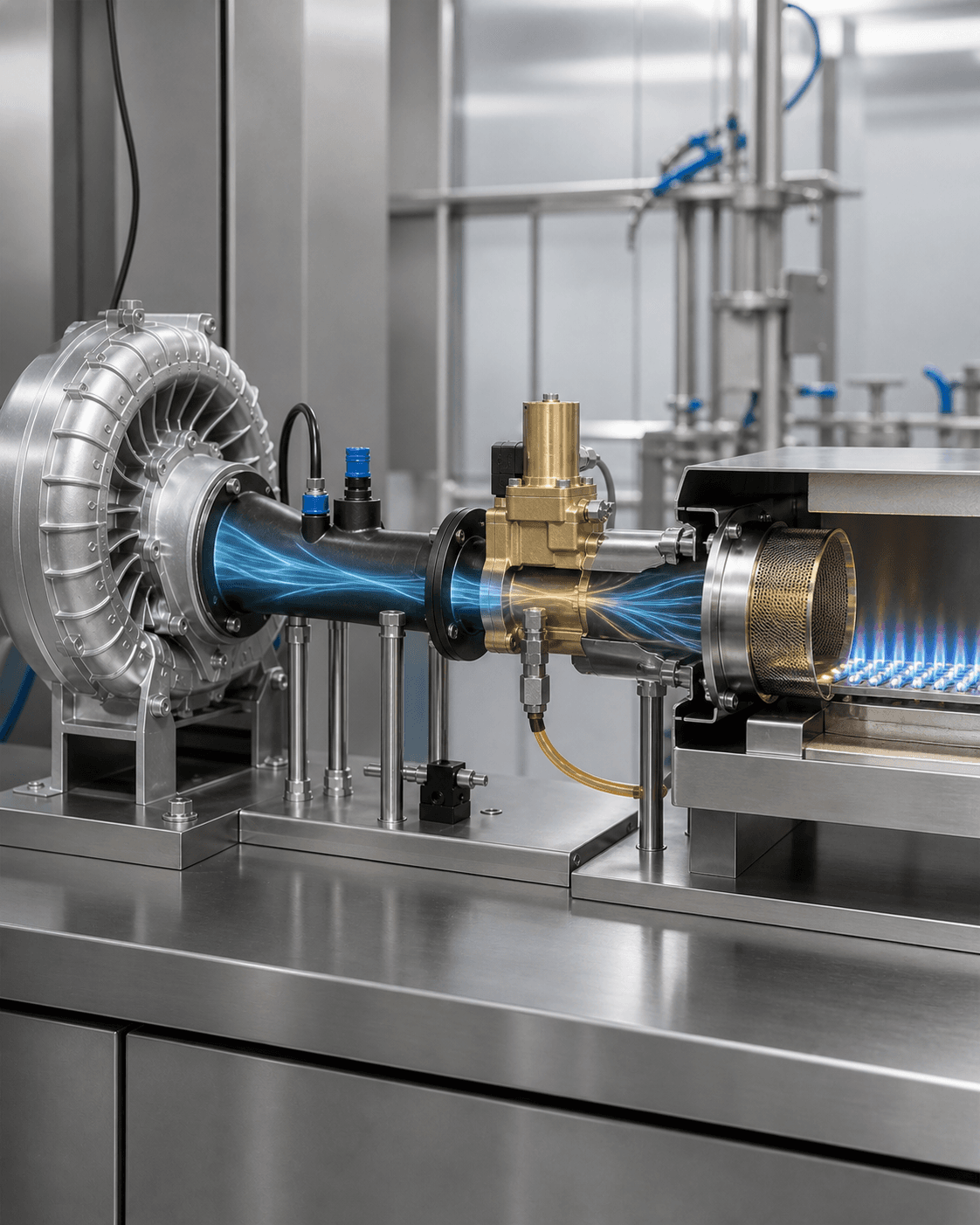
What the blower does
Airflow through the complete system
Provides stable, controllable combustion air so gas and air are thoroughly premixed before ignition, improving combustion efficiency, precision and flame stability.
- Commercial wok range and stir-fry cooker
- Gas cooking kettle and soup kettle
- Gas steamer and steaming cabinet
- Gas oven
- 01
Heat command
The appliance controller requests the required cooking heat output.
- 02
Controlled combustion air
The blower delivers repeatable airflow at the required pressure.
- 03
Gas-air premixing
Gas and air are thoroughly mixed before reaching the burner.
- 04
Stable cooking flame
The burner produces controlled heat for consistent cooking performance.
Recommended product range
Products for Food machinery
Select the blower from the required cooking heat output, airflow at static pressure, modulation range and the complete resistance of the premixer, burner and appliance airflow path.
Products for this application are being updated. Browse the complete product range or contact our team for selection support.
Bring us the equipment requirement
Send the target operating point and integration constraints. We will help evaluate a suitable blower direction and validation plan.
FAQ
Questions from equipment manufacturers
What do Full premix burner and Premix gas burner mean?+
These are overlapping market terms for burners that premix air and gas before combustion. Full premix burner, Full premixed burner, Full premix gas burner, Full premixed gas burner, Premix burner, Premix gas burner, Gas premix burner, and Premixed combustion burner may describe similar architectures, but their specifications vary. E-Power supplies blowers and matched components to a premix gas burner manufacturer; E-Power does not claim to manufacture the complete burner. The blower must be evaluated with the premixer, gas valve, burner surface, controller, fuel conditions, and flue resistance.
Can E-Power blowers work with metal-fiber or surface burners?+
E-Power blowers can be evaluated for systems using a Metal fiber burner, Metal mesh burner, Stainless steel fiber burner, Porous metal burner, or Fiber premix burner. These burner surfaces can differ in pressure loss, heat release pattern, thermal response, and acceptable air-gas distribution. Blower selection therefore cannot rely on burner diameter or rated heat input alone. The blower, premixer, gas valve, burner surface, controller, heat exchanger, and flue must be tested as one system across ignition, low load, rated load, maximum load, and load transitions.
Can E-Power blowers be evaluated for patient-warming equipment?+
E-Power blowers can be evaluated as components for a Medical warming blanket, Patient warming blanket, Patient warming system, Forced air warming system, or Forced air patient warming system. Related equipment may be described as a Forced air warming blanket, Surgical warming blanket, Operating room warming system, Patient temperature management system, or Patient warming device. These terms describe the finished application, not an automatic certification of the blower. The device manufacturer must validate airflow, heater coordination, temperature uniformity, alarms, noise, filtration, electrical safety, reliability, biocompatibility where relevant, and all applicable regulatory requirements.
Does E-Power provide OEM or application-specific blower solutions?+
E-Power supports OEM blower projects and application-specific matching based on technical feasibility, expected volume, and validation requirements. As an OEM blower manufacturer, the company can discuss voltage, control logic, communication functions, wiring, connectors, mounting interfaces, outlet configuration, and supporting components for suitable projects. The process normally begins with requirements review, followed by model screening, drawing and interface confirmation, samples, prototype testing, approval, and controlled production release. Available customization scope, minimum quantity, tooling, validation responsibility, and lead time must be confirmed for each project rather than assumed from a standard model.
What information should I provide for blower selection or a quotation?+
For a useful model recommendation or quotation, provide the equipment type, target airflow and static pressure at minimum, rated, and maximum load, supply voltage and frequency, control signal, speed-feedback requirement, and expected annual quantity. Include installation drawings, inlet and outlet dimensions, connector details, operating temperature, moisture, dust, grease or chemical exposure, noise targets, duty cycle, and any current blower model or curve. Combustion projects should also include available gas-valve, premixer, burner, fuel, gas-pressure, heat-exchanger, and flue information for engineering review.