
How Should Boiler OEMs Evaluate an EC Gas Blower Manufacturer?
Selecting an EC gas blower manufacturer is an engineering decision before it becomes a purchasing decision. The blower must provide the required combustion air across the equipment's operating range, communicate correctly with the controller, fit the available installation space, and deliver repeatable performance during production.
For a boiler manufacturer, a competitive quotation means little if the proposed blower cannot operate at the required airflow and static pressure. An incorrect selection may lead to unstable ignition, insufficient combustion air, excessive noise, unexpected electrical behavior, or expensive changes during product validation.
A suitable manufacturer should therefore demonstrate four essential capabilities:
-
Application matching: Selecting a blower according to the system's airflow-pressure requirements rather than maximum airflow alone.
-
Electrical and control compatibility: Confirming the power supply, speed-control signals, feedback functions, startup behavior, and fault response.
-
Manufacturing and quality verification: Providing relevant drawings, product data, inspection procedures, and testing evidence.
-
OEM engineering support: Helping equipment manufacturers evaluate samples, resolve integration issues, and establish a controlled production specification.
Ningbo E-POWER Energy Saving Technology Co., Ltd. develops and manufactures blowers, motors, and electronic control solutions for equipment manufacturers. Its EC Gas Blowers product range includes the D-RG77, D-RG118, D-RG138, D-RG148, and D-RG148H platforms for heating and combustion-air applications.
This guide explains how to evaluate a potential manufacturing partner, interpret real model specifications, avoid common sourcing mistakes, and prepare a technical request for quotation that supports a more reliable OEM purchasing decision.
Why Is the EC Gas Blower Critical to Boiler Performance?
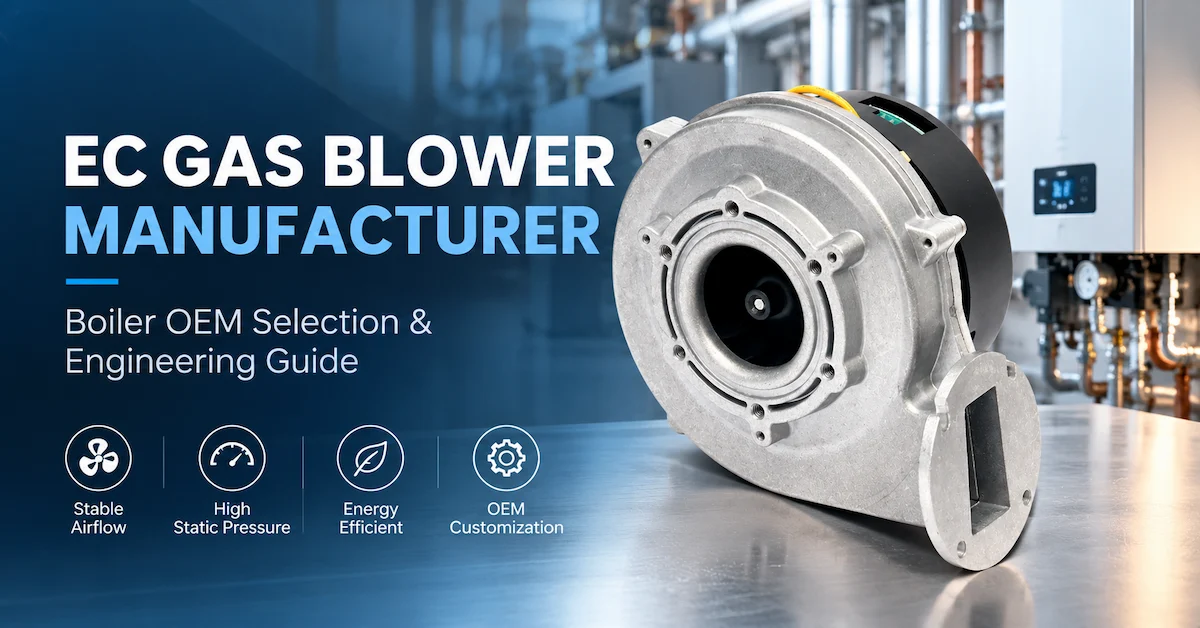
An electronically commutated gas blower combines a brushless motor and electronic commutation with a centrifugal air-moving assembly. In an appropriate combustion system, variable-speed operation allows combustion-air delivery to respond to changing heating demand.
The blower is part of a larger system, not an independent guarantee of combustion performance.
In a typical premixed gas boiler, the operating sequence involves air entering the appliance, the blower delivering combustion air, a gas-air mixing arrangement preparing the mixture, and a burner transferring heat through the heat exchanger.
The controller, gas valve, premixer, burner, and flue arrangement determine how the blower's output translates into actual combustion conditions.
Variable-speed combustion air supply
Many modern condensing boilers operate across a range of heating loads. A blower that performs adequately at maximum demand may behave differently during low-load operation, startup, or rapid modulation.
A suitable EC blower design allows the control system to request different operating speeds, subject to the particular model's control characteristics.
For an OEM engineer, the important questions include:
-
Can the blower provide sufficient pressure at the required minimum airflow?
-
Does it respond consistently to speed commands?
-
Does startup performance remain acceptable against actual system resistance?
-
Can the controller identify abnormal operation or missing feedback?
-
How does the blower behave when power or a control signal is interrupted?
These questions must be answered through the electrical documentation, performance curves, and prototype testing.
Motor efficiency is not the same as boiler efficiency
EC motor technology can offer energy-efficiency advantages over some conventional motor arrangements, depending on the operating point and the products compared.
However, improved blower motor efficiency does not automatically mean the complete boiler will achieve a specified percentage reduction in energy consumption.
Overall boiler performance depends on combustion conditions, heat-exchanger design, control strategy, fuel properties, heating demand, and other equipment-level factors.
Similarly, low-NOx performance cannot be attributed to the blower alone. Emissions must be assessed through the complete, properly configured combustion system.
This distinction matters when evaluating manufacturer claims. Reliable suppliers should explain how a component supports system development without promising unverified results for the finished appliance.
How to Match an EC Gas Blower to the Real Operating Point
The most important technical question for any EC gas blower manufacturer is whether the proposed blower can deliver the required airflow against the actual resistance of the combustion system.
Maximum airflow, maximum static pressure, and maximum rotational speed are useful specifications. However, none of these values independently demonstrates that a blower is suitable for a particular boiler.
Understanding airflow and static pressure
Airflow describes the volume of air moved through the system over time. It is commonly specified in cubic meters per hour (m³/h) or cubic feet per minute (CFM).
Static pressure describes the pressure difference associated with resistance in the airflow path. For blower selection, it is often expressed in pascals (Pa).
In a combustion application, the blower may need to overcome resistance from the air inlet, premixer, burner assembly, heat exchanger, flue arrangement, and other components.
The resistance changes with airflow. It may also change because of operating conditions, installation geometry, temperature, or restrictions in the system.
A manufacturer's performance curve shows the relationship between airflow and developed pressure under stated test conditions.
The correct selection begins by identifying where the system-resistance curve intersects the blower-performance curve.
Why maximum specifications can be misleading
Consider an illustrative boiler design requiring 100 m³/h of combustion air against 2,000 Pa of system resistance at a particular operating condition.
A blower datasheet might advertise 100 m³/h airflow and 3,800 Pa maximum static pressure.
Those two values do not establish that the blower can deliver 100 m³/h at 2,000 Pa.
Maximum airflow is often measured near a low-resistance condition, while maximum static pressure occurs at or near a very low-flow condition. The actual usable operating points lie between those endpoints.
The engineer must examine the complete performance curve to determine whether the required combination is achievable.
This hypothetical example is not a measured E-POWER product operating point. It illustrates why OEM customers should request curve data instead of selecting a blower from headline specifications.
Evaluate minimum, rated, and maximum heating loads
Boiler manufacturers should define more than one operating point.
|
Operating condition |
Engineering requirement |
Main evaluation concern |
|---|---|---|
|
Minimum heating load |
Lowest required combustion-air delivery |
Stable modulation and control |
|
Rated heating load |
Normal operating airflow and pressure |
Efficiency and continuous operation |
|
Maximum heating load |
Highest specified airflow against system resistance |
Available performance margin |
|
Ignition sequence |
Required pre-purge and startup behavior |
Safe and repeatable startup |
|
Rapid load transition |
Response during changes in requested heating output |
Control stability and transient behavior |
|
Abnormal condition |
Response to a fault or unexpected restriction |
Equipment safety strategy |
The supplier should help determine whether the selected blower has sufficient performance across the required range.
The boiler manufacturer must still perform complete equipment-level validation, particularly for ignition, combustion stability, emissions, and fault conditions.
Include environmental and installation effects
Bench-test performance is valuable, but actual equipment performance can differ.
Air density changes with temperature and atmospheric pressure. Inlet restrictions, duct bends, outlet transitions, enclosure geometry, and mounting conditions may influence blower performance.
For example, a compact wall-hung boiler may require a small blower assembly located near other components. The available mounting position could create additional inlet restrictions or complicate heat dissipation.
A commercial boiler may present different challenges involving operating duration, modular load control, or combustion-air routing.
For this reason, evaluating a manufacturer should include asking for dimensional drawings, performance curves, test conditions, and recommended installation arrangements.
E-POWER's residential heating solution specifically emphasizes matching airflow at static pressure while coordinating the blower with the gas valve, Venturi, modulation range, and heat-exchanger resistance.
Comparing E-POWER EC Gas Blower Models for OEM Applications
A manufacturer with multiple blower models gives equipment designers more opportunities to identify a suitable starting platform.
However, model selection must be supported by measurable differences rather than assumptions about product size or model numbering.
E-POWER's D-RG series includes several EC centrifugal blowers developed for heating and combustion-air applications.
The following comparison summarizes specifications currently published on the respective E-POWER model pages.
D-RG Series Technical Comparison
|
Model |
Published voltage |
Power input |
Published airflow |
Maximum static pressure |
|---|---|---|---|---|
|
100–120 / 220–230 VAC |
60W ±10% |
87 m³/h |
2,350 Pa ±5% |
|
|
220–230 VAC |
73 W ±10% |
100 m³/h |
3,800 Pa ±5% |
|
|
100–120 / 220–230 VAC |
300 W ±10% |
310 m³/h |
5,000 Pa ±5% |
|
|
100–120 / 220–230 VAC |
210 W ±10% |
220 m³/h |
4,100 Pa ±5% |
|
|
100–120 / 220–230 VAC |
300 W ±10% |
260 m³/h |
4,100 Pa ±5% |
Data note: Values are transcribed from current model pages for preliminary comparison. Voltage availability must be confirmed for the intended configuration. Published airflow and maximum static pressure are not simultaneous operating values, and all parameters should be reconfirmed against the approved datasheet before production.
D-RG77: Evaluate for compact combustion-air requirements
The D-RG77 combines a compact centrifugal housing with EC motor technology. Its published specifications include 60 W power input, 87 m³/h airflow, and 2,350 Pa maximum static pressure.
For an OEM developing a compact heating appliance, the model can serve as an initial candidate when the required duty points fall within its performance envelope.
That does not automatically make it suitable for every residential boiler. Engineers still need to confirm the operating curve, control configuration, installation geometry, and combustion-system requirements.
D-RG118: Evaluate when a different pressure-flow balance is required
The D-RG118 is another potential starting point for boiler and combustion-equipment development.
Its published page lists 100 m³/h airflow, 3,800 Pa maximum static pressure, and 73 W input power for the specified AC-powered version.
Compared with the D-RG77's published values, the D-RG118 offers a different performance envelope. Whether that difference is beneficial depends on the required duty point.
A proper comparison should consider the blower curves at the actual system resistance, not just the maximum pressure numbers.
D-RG138: Evaluate higher airflow and pressure requirements
The D-RG138 lists 310 m³/h airflow and a maximum static pressure of 5,000 Pa.
Those published figures may make it relevant for evaluating equipment with greater air-delivery requirements or higher resistance.
However, a higher published pressure rating is not automatically superior. Selecting more blower capability than necessary may create additional power, control, noise, or cost considerations.
The correct engineering decision depends on the complete system.
D-RG148 and D-RG148H: Compare related platforms
The D-RG148 and D-RG148H share a related housing family in the published dimensional documentation.
Their listed performance differs:
-
D-RG148: 210 W, 220 m³/h, maximum static pressure 4,100 Pa.
-
D-RG148H: 300 W, 260 m³/h, maximum static pressure 4,100 Pa.
These differences make their performance curves particularly important during evaluation.
A buyer should not assume that identical maximum static-pressure ratings indicate identical performance throughout the operating range.
The published pages also include dimensional and wiring information that can support a preliminary integration review.
What the model comparison does not establish
The table is useful for creating an initial shortlist. It does not establish final compatibility, efficiency at the required duty point, interchangeability, or finished-boiler performance.
Before selecting any D-RG blower, request the latest approved technical information and confirm the proposed electrical and mechanical configuration.
OEM engineers can review the broader EC Gas Blowers product range before selecting models for more detailed evaluation.
What Electrical and Control Capabilities Should an EC Gas Blower Manufacturer Provide?
Electronic control integration is one of the most important differences between selecting a generic ventilation blower and selecting a combustion-air blower.
A boiler controller needs predictable behavior, not simply a motor that can change speed.
PWM control and 0–10V control
Pulse-width modulation (PWM) communicates a control command using a pulsed signal. Depending on the design, the blower electronics interpret the signal's duty cycle to establish an operating request.
A 0–10V control interface uses an analog voltage signal as a command input.
Both approaches are found in variable-speed equipment, but their characteristics are not universally interchangeable.
The supplier should specify:
|
Control item |
What the OEM should confirm |
|---|---|
|
Input signal type |
PWM, analog voltage, or another supported interface |
|
PWM characteristics |
Frequency, duty-cycle range, logic level |
|
Analog input |
Voltage range, input characteristics, reference ground |
|
Command mapping |
Relationship between command and blower operation |
|
Minimum operating speed |
Lower control limit and startup requirements |
|
Maximum operating speed |
Upper limits under approved conditions |
|
Feedback |
Tachometer or other supported feedback signal |
|
Missing signal response |
Behavior after control-signal interruption |
|
Electrical connection |
Connector type, pin assignment, wiring diagram |
|
Fault response |
Protection behavior and available diagnostic information |
A common integration mistake is assuming that two blowers receiving the same PWM duty cycle will run at the same speed.
They may not.
Different electronic controllers can apply different command mappings, minimum speed limits, filtering, or startup logic.
An OEM should therefore request the actual control specification and validate the complete command range.
Why fail-safe behavior matters
Suppose a boiler controller loses communication with the blower.
What happens next depends on the blower electronics and the overall appliance safety design.
Some blower controllers may stop, while others may interpret a missing speed-control signal differently.
The E-POWER D-RG148 product page, for example, documents a particular PWM configuration in which full-speed behavior is associated with a disconnected PWM input or a 100% duty-cycle command.
This is an important engineering detail, but it must not be generalized to every D-RG model or custom configuration.
The equipment designer should explicitly confirm how the final supplied blower behaves during loss of control, unexpected signals, power interruption, and restart.
The boiler's own safety controller must implement the necessary protective functions.
Speed feedback and actual air delivery
Some EC blower configurations can provide a speed-feedback signal.
This may help the equipment controller monitor whether the motor is operating as expected.
However, motor speed is not a direct measurement of combustion-air mass flow.
The relationship between speed and airflow depends on the blower, pressure resistance, temperature, and other system conditions.
A speed-feedback signal alone cannot establish that the correct gas-air mixture is present.
For combustion equipment, electrical monitoring and combustion validation must work together within the overall control strategy.
How to Evaluate Motor Design, Mechanical Fit, and Component Quality
Selecting an EC gas blower requires examining both the motor and the centrifugal air-moving assembly.
The most suitable manufacturer should be able to explain how these elements interact with the customer's final equipment.
EC motor and electronic drive
The motor and electronic controller influence starting behavior, speed regulation, power consumption, and operating stability.
During technical review, buyers should examine the motor's specified supply conditions, operating limits, insulation requirements, and thermal behavior.
They should also ask whether the drive electronics are integrated into the blower assembly or supplied as part of a separate configuration.
The answer affects wiring, thermal management, equipment assembly, and future maintenance.
Impeller and housing design
The impeller and housing determine how the blower develops airflow and pressure.
Material selection depends on the intended operating environment, mechanical stresses, temperature exposure, and manufacturing design.
The D-RG77 and D-RG138 product pages, for example, identify plastic impellers in their published specifications.
A buyer should not infer that every D-RG model uses the same material or that all versions have identical environmental limits.
Important questions include whether the housing material suits the expected operating conditions, how the impeller is balanced, and whether the mounting arrangement supports stable operation.
Mechanical installation details
A dimensionally similar replacement may still be mechanically incompatible.
Engineers should compare:
-
Overall housing dimensions and installation clearance.
-
Mounting-hole positions and permitted orientation.
-
Inlet geometry and outlet connection.
-
Shaft and motor position.
-
Connector access and wire routing.
-
Proximity to hot surfaces and moving components.
-
Sealing requirements and potential vibration transfer.
For example, the D-RG148 family has published dimensional drawings that identify the housing geometry, mounting points, and connector locations.
Those drawings are more useful than a product photograph when determining whether the blower will fit an existing boiler platform.
Before tooling or production approval, both parties should work from a controlled version of the same mechanical drawing.
What Manufacturing Capabilities Matter When Choosing an EC Gas Blower Manufacturer?
An EC gas blower manufacturer should demonstrate more than the ability to assemble a motor and housing.
For equipment OEMs, supplier capability is closely connected to repeatability, engineering communication, production control, and traceable verification.
E-POWER states that its operations bring together motor engineering, electronic control development, airflow design, manufacturing, and product validation.
Its About Us page describes capabilities involving motor and PCB development, control software, automated winding, pressing, balancing, assembly, and in-house performance testing.
Integrated engineering support
A supplier with relevant motor, electronics, and airflow expertise may be better positioned to evaluate interactions between electrical control and aerodynamic performance.
For example, a customer's requested speed range may appear reasonable electrically but may not satisfy the required airflow-pressure curve.
Similarly, changing an impeller, housing, or motor setting can influence other operating characteristics.
Engineering decisions should therefore be reviewed as a complete configuration rather than as unrelated component changes.
Prototype support and production transition
OEM development normally involves more than receiving a single product sample.
The buyer may need to validate several operating conditions, adjust the installation arrangement, or confirm wiring and control compatibility.
A suitable supplier should provide an understandable path from initial specification review to sample approval and repeatable production.
For E-POWER, the publicly described services include technical product selection, fan-system matching, sample development and testing, performance optimization recommendations, and volume-supply coordination.
Specific development schedules, sample quantities, commercial conditions, and project deliverables should be confirmed separately.
Manufacturing consistency
A sample can perform well while production quality remains difficult to control.
This makes process consistency an important supplier evaluation factor.
Procurement teams should ask how critical characteristics are controlled across production batches.
Examples include impeller balance, assembly accuracy, electrical performance, connector integrity, noise, and final functional operation.
When appropriate, an OEM may also request information about change control, production traceability, inspection records, and corrective-action procedures.
These requirements should be agreed upon according to the complexity and risk level of the equipment project.
Which Quality-Control Tests Should OEM Buyers Request?
Quality-control evidence helps distinguish a technically qualified manufacturing partner from a supplier providing only marketing statements.
E-POWER's published quality process includes incoming inspection, in-process control, outgoing inspection, and reliability-related testing.
The specific tests and acceptance criteria needed for a purchasing project should still be agreed upon for the selected model.
1. Incoming material inspection
Incoming inspection can help control variations in motors, electronic components, plastic parts, bearings, and other materials.
A technical buyer should ask how the manufacturer handles incoming components that fail inspection and whether critical purchased parts are subject to supplier qualification.
2. Airflow and static-pressure testing
The most relevant aerodynamic test is one that establishes blower performance under known conditions.
For technical comparison, OEM engineers should request the test setup, air density or environmental conditions, measurement method, and applicable uncertainty where available.
Recognized industry references include ISO 5801:2017, Fans—Performance Testing Using Standardized Airways (including its 2025 amendment), and ANSI/AMCA 210-2025 / ASHRAE 51-2025, Laboratory Methods of Testing Fans for Certified Aerodynamic Performance Rating.
These are references for discussing test methodology. Their mention does not mean E-POWER has certified any particular blower to those standards.
A useful test report should clearly associate the measured airflow and pressure values with the corresponding operating conditions.
3. Motor and electrical testing
Depending on the final design, relevant checks may include supply-current behavior, motor operation, insulation-related requirements, electronic control response, and abnormal-condition behavior.
The OEM should request the applicable electrical test requirements rather than assume that every blower requires an identical test program.
4. Noise and vibration
Noise levels can be important for residential boilers, commercial heating equipment, and installations near occupied spaces.
Measurements depend strongly on operating conditions, mounting arrangements, and test methods.
A manufacturer may report an acceptable noise level on a test bench, but installation inside a boiler enclosure can produce a different acoustic result.
For meaningful comparison, request noise data at relevant operating points and review the test conditions.
Vibration checks are also useful for identifying mechanical imbalance or assembly-related concerns.
5. Aging and reliability testing
An aging test can help identify certain early failures, but it should not be confused with proof of an unlimited service life.
For long-term OEM programs, customers should discuss the expected operating profile, environmental conditions, duty cycles, and applicable reliability objectives.
The supplier's test records should be reviewed in relation to those requirements.
6. Certificates and market compliance
E-POWER's About Us page presents an ISO 9001 quality-management certificate with a scope covering the design, production, and sale of small-power motors and centrifugal blowers.
Product pages also discuss international compliance documentation, including CE, LVD, RoHS, REACH, and cUL-related items.
However, a company-level management certificate does not establish that every model possesses every product certification.
OEM purchasers should request documentation for the exact product configuration and target market, including applicable certificate numbers, test reports, validity, and scope.
The boiler manufacturer must separately determine the regulatory requirements applicable to the finished combustion appliance.
OEM Customization: What Can Be Discussed With the Manufacturer?
A standard blower may not meet every equipment manufacturer's requirements.
Boiler manufacturers differ in their electrical architecture, installation geometry, system resistance, operating environment, and control strategy.
This creates demand for application-specific engineering support.
E-POWER's published OEM/ODM capabilities include airflow and pressure adjustment, motor parameter matching, electrical interface customization, structural optimization, and control-system integration.
The actual customization options depend on the model, engineering feasibility, validation requirements, and commercial agreement.
Possible customization discussions
|
Customization area |
Typical OEM requirement |
What must be confirmed |
|---|---|---|
|
Airflow performance |
Match equipment duty points |
Curve and allowable configuration changes |
|
Electrical supply |
Match regional equipment architecture |
Supply rating and approved variant |
|
Control interface |
Match existing boiler controller |
Signal, connectors, mapping and faults |
|
Mechanical interface |
Fit appliance housing |
Drawings, mounting and clearances |
|
Wiring arrangement |
Support production assembly |
Connector, harness and pinout |
|
Motor parameters |
Meet the required operating range |
Thermal and aerodynamic implications |
|
Testing requirements |
Support customer qualification |
Test conditions, scope and acceptance limits |
A useful OEM development project begins with the customer's existing equipment requirements.
It should not begin with a vague request to make the blower more powerful, quieter, or more efficient.
Those objectives must be translated into measurable targets before engineering work can be evaluated.
How to avoid unnecessary customization costs
Customizing a blower may introduce tooling, engineering, validation, inventory, or maintenance implications.
It is often sensible to evaluate a standard product first.
If a suitable existing model meets the essential requirements, the OEM can reduce the number of changes that need to be tested and controlled.
Where customization is necessary, prioritize changes that solve specific equipment problems rather than cosmetic differences without operational value.
Explore the available E-POWER EC Gas Blower models or contact the engineering team to discuss a model shortlist for your equipment.
Which Applications Create the Strongest Demand for EC Gas Blowers?
Different combustion applications produce different purchasing requirements.
A manufacturer suitable for one application may not automatically be the best technical match for another.
Residential condensing boilers
Residential wall-hung boilers commonly operate under changing heating demand.
Typical engineering priorities include compact installation, variable-speed control, acoustic behavior, and reliable performance over the operating range.
The blower must work with the gas valve, premixer, heat exchanger, air inlet, and flue arrangement.
For equipment manufacturers developing a new wall-hung boiler, control compatibility and low-load behavior deserve particular attention.
Commercial and modular boilers
Commercial boiler systems may use several modules to accommodate changes in building heating demand.
Each active module requires appropriate combustion-air delivery.
Evaluation may also need to address module sequencing, shared flue behavior, operating duration, and control interactions.
E-POWER identifies commercial condensing and modular boilers among the applications for its combustion blower products.
More information about this application is available on the Commercial Boilers solution page.
Industrial heating equipment
Industrial heating applications can involve different system resistance, operating schedules, and environmental conditions.
Depending on the equipment, engineers may need to evaluate sustained operation, heat exposure, structural installation, and special control requirements.
The actual suitability of a blower must be established for the intended industrial equipment, not inferred from its use in a residential boiler.
Premixed gas burner systems
In a premixed burner system, the blower works with components that control gas and air delivery.
The overall design may involve a proportional gas valve, Venturi premixer, burner surface, and electronic controller.
A change to the blower can affect the conditions presented to other components.
For this reason, component substitution requires system-level review and combustion testing.
E-POWER provides more information about related components and system matching on its Gas Burner Systems page.
Commercial gas cooking equipment
Certain commercial cooking appliances also require controlled combustion-air delivery.
These systems may involve repeated load changes, demanding installation environments, and different burner arrangements.
A suitable blower should be evaluated against the actual appliance requirements, including maintenance conditions and environmental exposure.
The manufacturer must not assume that an established boiler configuration can be used unchanged in commercial cooking equipment.
How to Prepare an Effective RFQ for an EC Gas Blower Manufacturer
An incomplete request for quotation often produces an incomplete technical proposal.
For example, asking for the price of a 200 m³/h EC blower does not explain the required static pressure, power supply, mounting arrangement, or control interface.
Suppliers may respond with models that appear similar on paper but differ significantly in actual suitability.
A detailed RFQ makes technical comparison more efficient.
Recommended OEM RFQ checklist
|
Information required |
Details to provide |
|---|---|
|
Equipment type |
Condensing boiler, commercial boiler, gas burner, or another application |
|
Heating capacity |
Minimum, rated, and maximum equipment heating input where relevant |
|
Airflow requirements |
Required airflow at each operating condition |
|
Static pressure |
Pressure resistance corresponding to each airflow requirement |
|
Electrical supply |
Supply voltage, frequency and permitted tolerance |
|
Control requirements |
PWM, 0–10V, feedback and other interface needs |
|
Mechanical limitations |
Available space, mounting points and outlet configuration |
|
Operating environment |
Temperature, humidity and other applicable conditions |
|
Noise requirements |
Target limits and measurement conditions |
|
Applicable compliance |
Required product and finished-equipment documentation |
|
Sampling requirements |
Sample quantities and intended evaluation schedule |
|
Purchasing plan |
Forecast volume, project stage and delivery destination |
A preliminary quotation may be possible with fewer details. However, accurate technical qualification usually requires substantially more than a model name and an annual purchase forecast.
Request the correct engineering documents
Depending on project requirements and document availability, OEM buyers should request:
-
Latest approved product datasheet.
-
Airflow-pressure performance curves.
-
Dimensional and installation drawings.
-
Electrical wiring and control-interface specification.
-
Relevant inspection and testing information.
-
Applicable product compliance documentation.
-
Sample identification and configuration records.
These documents allow engineering and purchasing teams to evaluate the same proposed product.
They also help prevent disputes caused by differences between the initial sample, quoted configuration, and later production version.
A practical supplier evaluation process
A disciplined sourcing process can be organized into five stages.
Stage 1: Technical screening. Compare available blower platforms against the essential duty points, voltage, control, and mounting conditions.
Stage 2: Documentation review. Examine drawings, performance curves, and the actual configuration proposed for testing.
Stage 3: Prototype evaluation. Install the sample in the intended equipment and assess operation across relevant loads and fault conditions.
Stage 4: Commercial qualification. Review pricing, quality requirements, production planning, packaging, shipment, and change-management expectations.
Stage 5: Production approval. Establish the approved configuration, inspection criteria, and responsibilities before starting regular purchasing.
The precise steps depend on the customer's project and contractual arrangements.
For E-POWER, the recommended starting point is to submit operating requirements through the Contact Us page, enabling the team to evaluate the suitable product direction.
Comparing Purchase Price With Total OEM Procurement Cost
The lowest quoted blower price does not necessarily result in the lowest project cost.
Industrial OEM procurement includes costs associated with engineering qualification, installation, production, logistics, quality, and future maintenance.
The most useful commercial comparison considers the complete purchasing decision.
Initial purchase price
The unit price is important, particularly for a long-term production program.
However, quoted prices should be compared only after the technical configuration and commercial terms are understood.
Otherwise, a lower quote may represent a different motor, control interface, product version, or scope of supply.
Engineering and validation costs
Every unsuccessful sample evaluation consumes engineering time.
If the selected blower cannot meet the intended operating point, the OEM may need to repeat testing, alter the installation, or change the controller configuration.
Obtaining complete technical information before placing an order can reduce avoidable evaluation work.
Production and quality risks
Variation between production batches can affect assembly efficiency, product consistency, and warranty exposure.
For this reason, a supplier's documentation and quality-control system may be as important as its initial quotation.
Where necessary, customers should agree on inspection requirements and procedures for handling nonconforming products.
Logistics and supply continuity
International procurement also involves packaging, freight, customs, inventory planning, and potential schedule disruptions.
A quotation should clearly identify the applicable delivery terms, packaging arrangement, and responsibilities.
MOQ and lead time should be confirmed for the exact model, quantity, and configuration rather than inferred from generic manufacturer claims.
A better total-cost perspective
A simple procurement cost framework is:
Total procurement cost = Product purchase cost + Engineering qualification cost + Logistics cost + Inventory cost + Quality-related cost + Applicable customization cost.
Not every project will have a significant amount in every category.
Nevertheless, considering these factors can produce a more rational supplier decision than comparing unit prices alone.
Common Mistakes When Sourcing From an EC Gas Blower Manufacturer
Several recurring mistakes can delay an otherwise promising OEM project.
Mistake 1: Selecting by maximum airflow alone
Maximum airflow does not establish suitability at the required system resistance.
Better approach: Compare the required operating points against the performance curve.
Mistake 2: Assuming all EC blowers have identical control behavior
The label EC does not define one universal control interface.
Better approach: Confirm the exact PWM or analog input specification, feedback arrangement, startup characteristics, and fault behavior.
Mistake 3: Choosing a larger model without engineering justification
Higher maximum pressure, airflow, or power does not automatically mean better system performance.
Better approach: Select according to required performance margin, operating efficiency, integration, and total cost.
Mistake 4: Ignoring the installed environment
A blower may perform differently when installed near heat sources, restrictive inlets, or vibrating structures.
Better approach: Evaluate it in the intended assembly under representative conditions.
Mistake 5: Assuming a generic certification claim covers every configuration
A manufacturer's quality-management certificate and an individual product's compliance documentation serve different purposes.
Better approach: Request model-specific evidence relevant to the importing market.
Mistake 6: Ordering customized parts before approving technical specifications
Unclear specifications can create disagreements over the final product.
Better approach: Approve drawings, electrical requirements, acceptance criteria, and version identification before production.
Mistake 7: Treating the blower as a complete combustion solution
A combustion blower supplies air; the finished combustion system determines the actual combustion outcome.
Better approach: Validate the blower, gas valve, premixer, burner, controls, and related equipment together.
Avoiding these mistakes makes manufacturer selection more systematic and helps purchasing teams concentrate on meaningful technical and commercial differences.
Frequently Asked Questions About EC Gas Blower Manufacturers
What is an EC gas blower manufacturer?
An EC gas blower manufacturer develops or produces electronically controlled blower assemblies that supply air for suitable heating and combustion applications.
A technically capable manufacturer may also support motor development, electronic control, airflow testing, mechanical integration, and OEM customization.
For industrial buyers, the relevant question is not simply whether the supplier offers an EC motor. It is whether the proposed blower assembly can be qualified for the intended combustion equipment.
E-POWER offers D-RG series EC gas blowers and related engineering support for equipment manufacturers.
How do I select an EC gas blower for a condensing boiler?
Start by determining the required airflow and static pressure across the boiler's operating range.
Then compare those requirements against the manufacturer's performance curves.
Confirm the electrical supply, speed-control signals, mechanical dimensions, environmental conditions, and installation requirements.
Finally, validate the selected blower with the actual gas valve, premixer, burner, heat exchanger, controller, and flue arrangement.
A published maximum airflow rating alone is insufficient for approval.
What is the difference between an EC gas blower and a conventional AC blower?
An EC blower uses electronic commutation, typically with a brushless motor arrangement, to support electronically controlled motor operation.
Conventional AC blower architectures may employ different motor and speed-control technologies.
The practical differences depend on the complete designs, including motor efficiency, drive electronics, control functionality, and operating conditions.
Neither technology should be evaluated solely by name. Equipment manufacturers should compare performance, compatibility, energy use, noise, reliability requirements, and acquisition cost for the actual application.
Can every EC gas blower use PWM or 0–10V control?
No. Support for PWM or 0–10V control depends on the model and supplied configuration.
Even when two products support the same general signal type, their command mapping, signal levels, allowable range, and fault behavior may differ.
Before integrating a blower with a boiler controller, request the exact wiring and control documentation.
The manufacturer should confirm the appropriate interface for the selected product version.
Can an EC gas blower reduce boiler emissions?
An appropriately selected and controlled blower can support the development of a well-regulated combustion-air supply.
However, the blower alone cannot guarantee lower NOx emissions, a particular combustion efficiency, or stable operation under every condition.
Those outcomes depend on the complete system design, including fuel characteristics, burner geometry, air-fuel ratio control, heat exchanger, controller, and flue.
Emission performance must be validated on the finished equipment using the applicable test procedures.
What certifications should I request from an EC gas blower supplier?
Request documentation relevant to the exact blower model, electrical configuration, intended use, and destination market.
This may include quality-management certification, applicable electrical safety documentation, material compliance declarations, and relevant product test reports.
The necessary documents depend on regulatory applicability.
Do not assume that a company-level ISO 9001 certificate establishes compliance of every individual product with all target-market requirements.
Can I replace an existing combustion blower with another manufacturer's model?
A replacement may be technically possible, but matching nominal voltage or physical size does not establish interchangeability.
Compare the airflow-pressure curves, wiring, control response, feedback, startup characteristics, mounting, environment, and protection behavior.
Because the blower influences the combustion system, changes must also be evaluated against the appliance's approved design and safety requirements.
Unverified substitutions should not be treated as direct replacements.
What information should I send to receive an OEM quotation?
Provide the equipment application, required airflow-pressure duty points, electrical supply, control requirements, mounting constraints, operating environment, sample needs, and expected purchasing volume.
If available, include a drawing of the intended installation and details of the existing or target control system.
These materials help the manufacturer identify suitable standard models and assess whether application-specific development is required.
You can submit the requirements through E-POWER's inquiry page.
Conclusion
Choosing the right EC gas blower manufacturer requires more than comparing prices, motor power, or maximum airflow. Boiler and combustion equipment OEMs should prioritize performance at the actual operating points, electrical compatibility, reliable manufacturing quality, accurate technical documentation, and engineering support throughout product validation.
E-POWER's D-RG series provides several EC combustion blower platforms that can be evaluated for residential heating, commercial boilers, and other combustion-air applications. Final suitability must always be confirmed through model-specific documentation and equipment-level testing.
Explore the E-POWER EC Gas Blower range or contact E-POWER to discuss your OEM blower requirements. Share your airflow, static pressure, control, and installation specifications to begin a focused technical evaluation.