
Choosing a blower starts with airflow and pressure, but a successful equipment project depends on much more: the actual operating point, mechanical interfaces, electrical control, repeatable production and test records. A sample that performs well on a bench still has to work in the customer's complete system.
This is how we introduce Ningbo Yingdong Energy Saving Technology Co., Ltd. (E-POWER): through the products we offer, the engineering questions we help customers resolve, and the manufacturing and quality processes behind each project.
1 Define the Supplier's Product and Service Boundaries First
Company introductions often begin with size, credentials and awards. Engineering customers tend to ask something else first: which capabilities are performed in-house, which conclusions have test records behind them, and who can discuss an application that behaves differently from expectations? These answers directly affect prototype and production decisions.
E-POWER's principal products are EC centrifugal blowers. A blower can be tested on a workbench, but its installed performance also depends on air-path resistance, medium conditions, power supply, control strategy and available space. This is especially true in fully premixed combustion, HVAC, steam and environmental-control equipment. In these systems, blower specifications must be interpreted within the operating logic of the complete appliance.
E-POWER should therefore not be assessed from one sample or one curve alone. A clearer picture emerges by following a customer project: how is the product platform selected, how are related components specified, and do engineering validation, production equipment, quality records and after-sales feedback form a coherent process? That process reveals the supplier's actual scope.
2 From Motor Manufacturing Experience to EC Blower Specialization
Ningbo Yingdong Energy Saving Technology Co., Ltd. was established in 2018 and focuses on EC blowers. The company independently operates its product development and design, manufacturing, sales and service. Existing company information indicates approximately 2,500 square meters of production space and a team of about 30 people. This dedicated team concentrates its engineering and manufacturing work on blower projects, while the wider website catalog presents related products for equipment integration.
E-POWER's manufacturing background is linked to Dacheng Electromechanical. Founded in 1991, Dacheng has long produced AC, DC and brushless DC motors and has developed experience in production, international trade and supply-chain coordination. For EC blowers, the value of that experience is not just its duration: it includes practical knowledge of windings, motor structures, volume-production processes, component management and shop-floor operations.
Moving from standalone motors to EC centrifugal blowers adds more interdependent elements. The motor, control board, impeller and volute must work together, while control software directly affects startup, speed regulation, protection and feedback. Building on its motor-manufacturing experience, E-POWER has developed electronic-control and aerodynamic design capabilities, extending its work from making motors toward matching complete blower systems.
The website brings these capabilities together in five product families: Gas Blowers, Centrifugal Blowers, Electric Motors, Electrical Speed Controllers and Integrated System Solutions. EC gas blowers remain E-POWER's central focus; the broader catalog helps customers find related air-moving, drive and control products in one place.
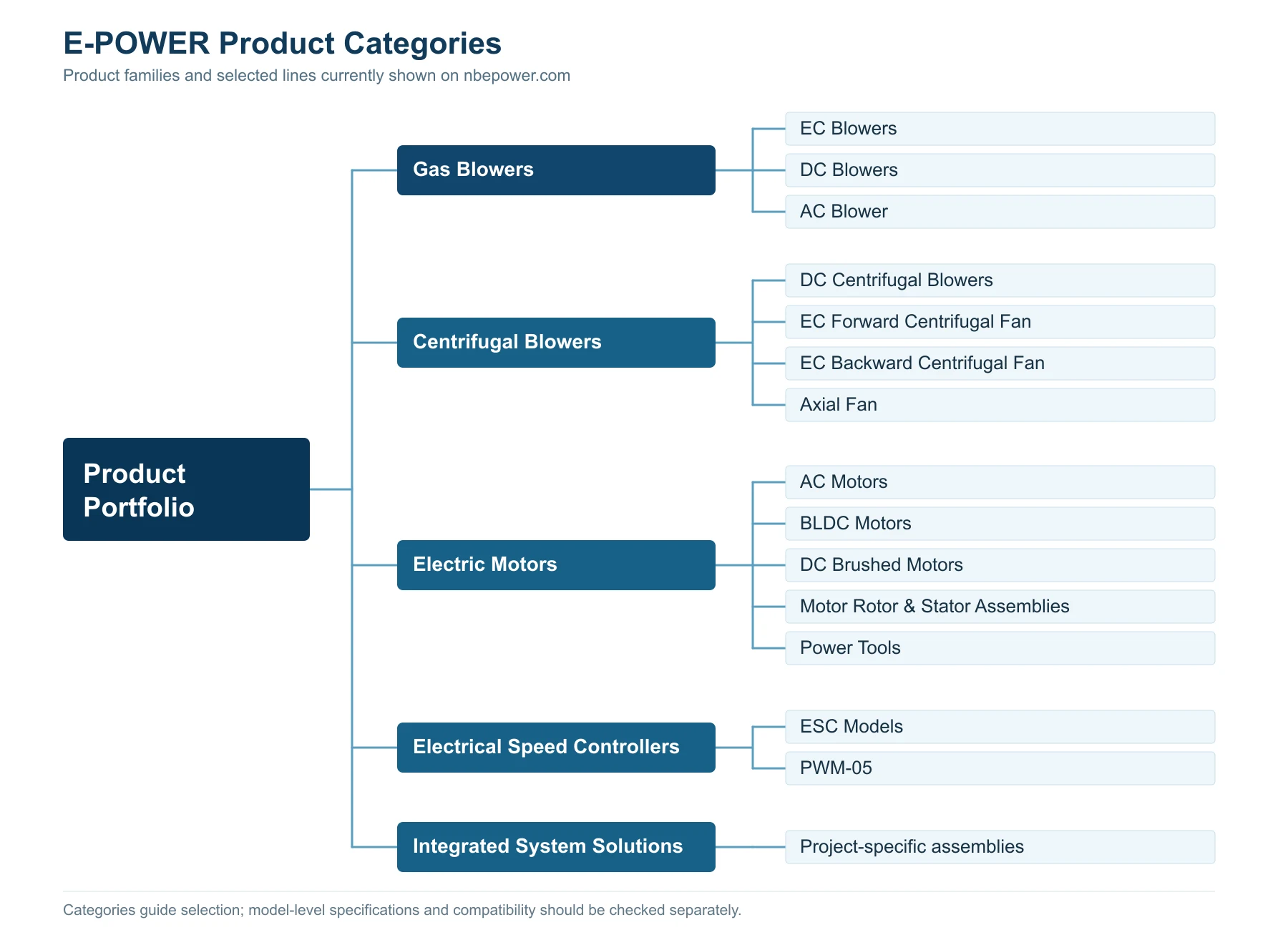
Product families currently shown on the E-POWER website. Model-level specifications and compatibility should be checked separately.
3 EC Centrifugal Blower Platforms and Selection Logic
The EC gas blower range includes D-RG77, D-RG118, D-RG138, D-RG148 and D-RG170 platforms, with model-specific variants listed in the product catalog. Depending on the model, electrical supply, impeller, housing, outlet and control interface may differ. These details matter as much as the headline airflow or pressure figure.
Model numbers distinguish platforms and structures; they are not a capacity ranking from small to large. Selection should instead place the target points at minimum, rated and maximum load on each candidate blower curve. Voltage, power, speed-control input, feedback, inlet clearance, outlet direction and mounting holes must then be checked. Similar appearance or maximum values do not guarantee similar performance in the finished equipment.
E-POWER can use its existing platforms and the project requirements to shortlist models. Final approval must still rest on model-specific documentation and prototype testing. New equipment can reveal interface issues before its mechanical design is frozen. For a replacement project, the incumbent blower, measured performance and mechanical and electrical boundaries that must remain unchanged should all be included in the comparison. A replacement is only comparable when the original conditions are clear.
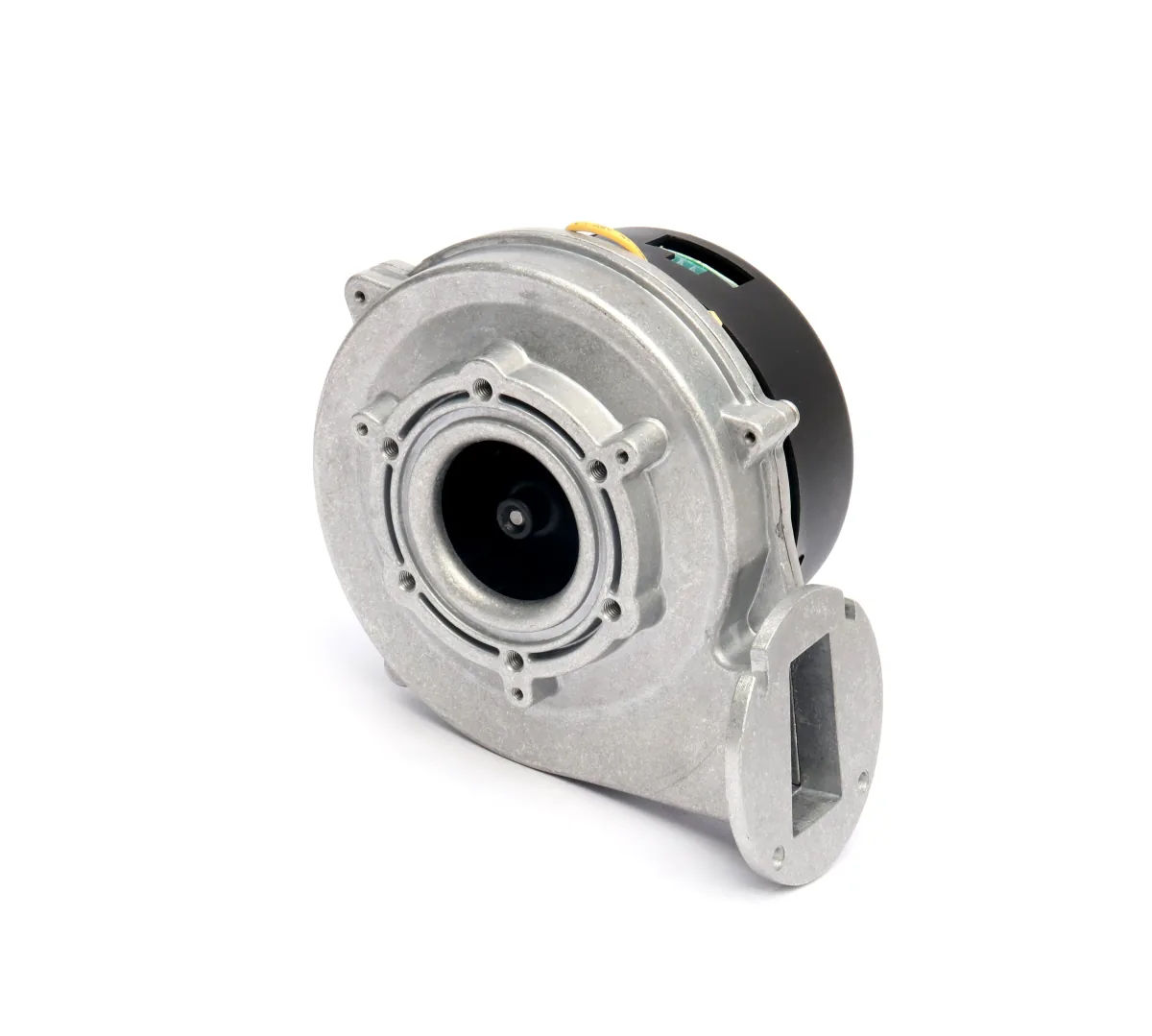
D-RG118 EC gas blower, shown from the front inlet side.
4 Related Components for System Interfaces
Beyond the blower itself, the website presents speed controllers, electric motors and integrated system solutions. E-POWER's project materials also cover premixers, gas valves, filters, circuit boards and blower-related assemblies. These items address power, control, connection and protection requirements that often appear during equipment integration. Their suitability must be confirmed for the selected blower and application.
In a fully premixed combustion system, the blower, premixer, gas valve and burner form a connected air-gas control loop. E-POWER's materials show premixers of different sizes and assemblies involving 2012, 508 and VK4405 gas valves, including D-RG148 with a 508 valve and D-RG138 with a VK4405 valve. These examples are useful for discussing mounting and interfaces. A change in burner or control strategy still requires the assembly to be validated again.
Controllers and blower speed controllers deal mainly with power, speed regulation or appliance control. Filters affect inlet protection and resistance over time. The appropriate combination depends on the model, control logic and operating environment. These components allow the parties to discuss not just whether a blower runs, but whether it adjusts smoothly, whether inlet components can be maintained, and whether the complete equipment remains stable across its load range.
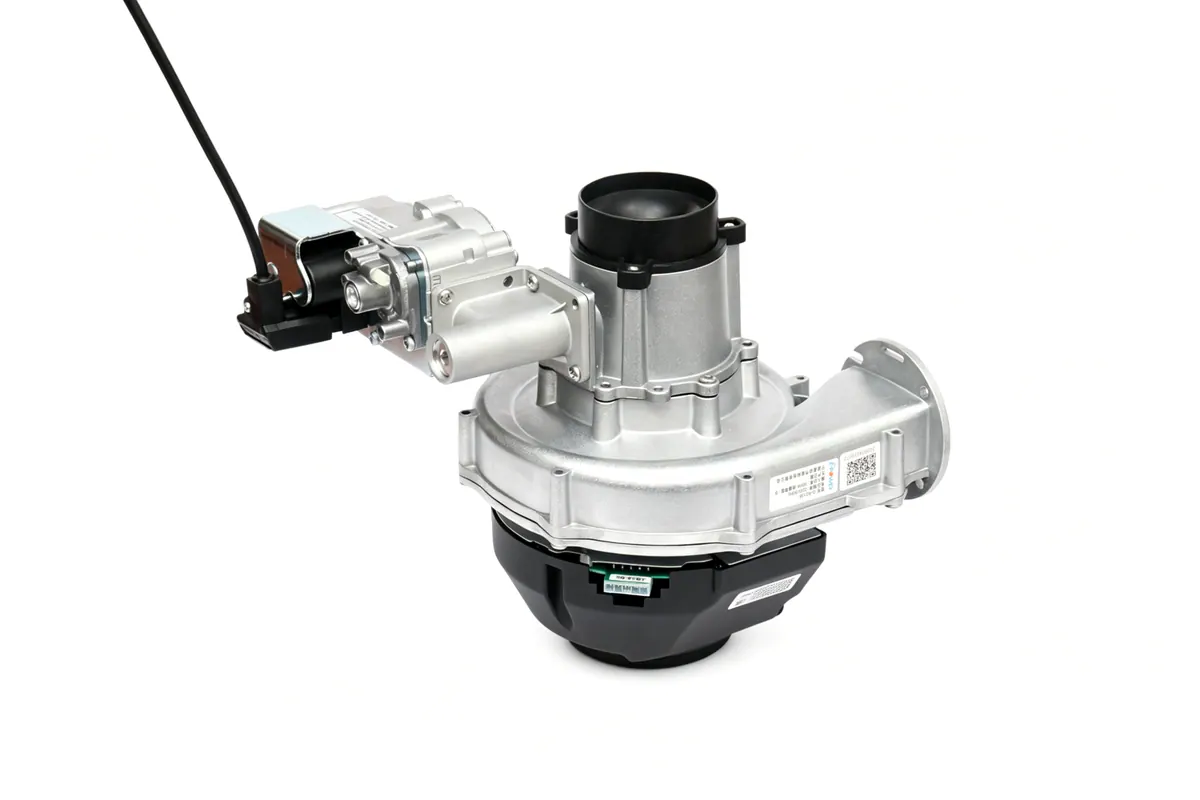
D-RG138, VK4405 gas valve and premixer assembly; configuration must be validated for the project
5 Different Applications Require Different Performance Priorities
E-POWER blowers are currently aimed at fully premixed gas appliances, HVAC equipment, surface-combustion equipment, commercial kitchens, environmental dust extraction, medical temperature-control equipment and steam generators. A platform used in different equipment may have a different operating point and entirely different evaluation priorities. The application name is only the first layer of project information.
For non-combustion air-moving tasks, customers can also explore the site's EC forward-curved and backward-curved centrifugal fans, axial fans and DC centrifugal blowers. These are separate product families with different installation and performance characteristics; they should not be treated as interchangeable with gas blowers.
Combustion equipment calls for checks of modulation range, ignition response, air-gas coordination and flue conditions. HVAC equipment places greater emphasis on continuous operation, noise, temperature rise and performance as filters load. Dust and fume extraction equipment faces particulates, oil mist and rising resistance. Medical temperature-control and other environmental-control devices may be more sensitive to low-load adjustment, smooth response and noise. There is no universal ranking of these criteria.
Experience helps ask the right questions but does not replace validation. Early in a project, confirm where target airflow and pressure will be measured, how medium temperature changes, whether operation is continuous, and whether condensate, dust or power-supply fluctuation is expected. The earlier these boundaries are defined, the closer the candidate models will be to real requirements and the more useful prototype testing becomes.
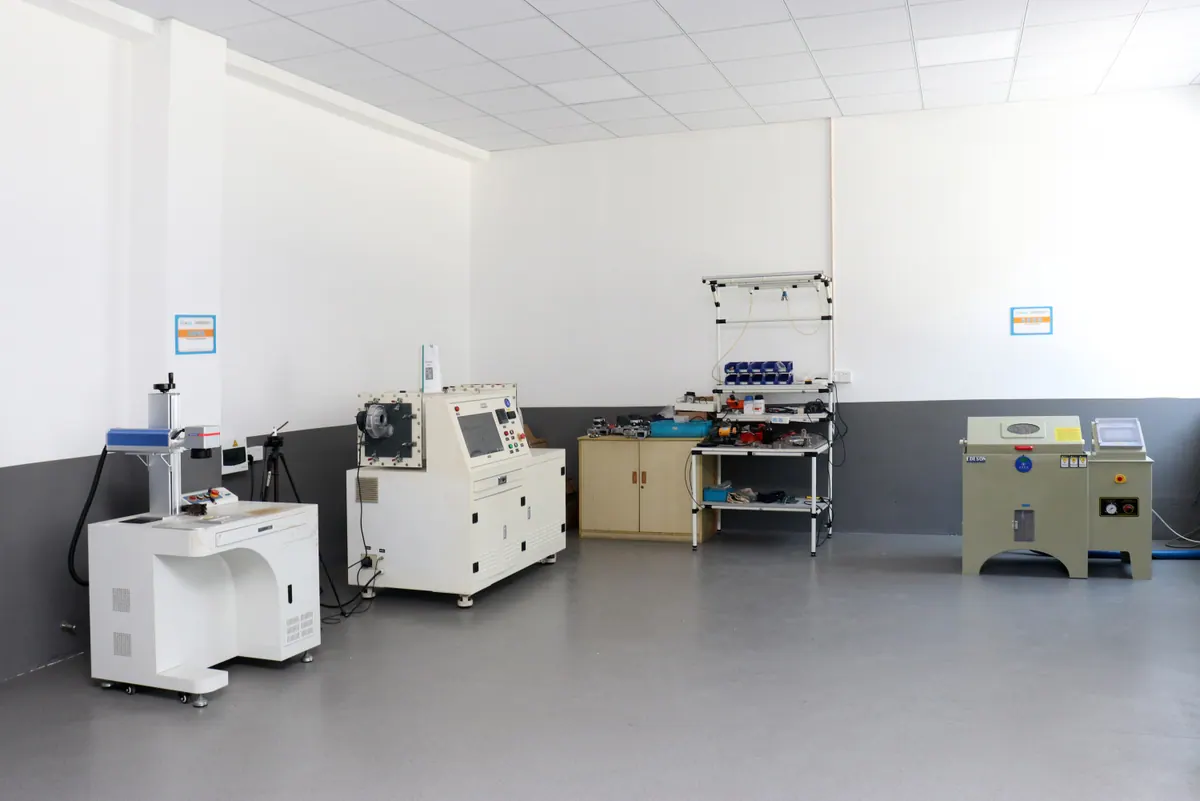
E-POWER laboratory and test area: different equipment checks aerodynamic, material and environmental conditions
6 Engineering Validation Covers Motors, Controls and Aerodynamics
According to existing company information, E-POWER's development work includes motor design, electronic-control software and wind-tunnel-based aerodynamic design, supported by corresponding test facilities. Material tests, motor performance tests, airflow and pressure measurements, and temperature-humidity, salt-spray, dust and vibration testing answer different questions about material, electrical and aerodynamic performance and environmental suitability.
Testing does not end when one blower has passed a bench test. Product development balances speed, pressure, temperature rise, noise, efficiency and protection limits. A customer project adds real mounting, duct resistance, control commands and load transitions. Bench data provide a comparable baseline; complete-appliance validation determines whether the prototype actually works in its intended equipment.
Test results are comparable only when the conditions accompany them. Records should state where airflow and pressure were measured, the medium temperature, inlet and outlet connections, power-supply status and control command. This helps compare structural variants and reduces the risk of mistaking a measurement difference for a product difference. Agreeing on test methods at the customer prototype stage is particularly important.
7 Manufacturing for Batch Consistency and Dependable Supply
A working engineering sample shows that a design may be feasible. At procurement and production scale, customers also need consistency across batches, dependable lead times and a way to address deviations. According to E-POWER's existing company introduction, its blower production line is planned for an annual capacity of 100,000 units and includes automatic winding machines, servo presses, dynamic balancing machines, automatic adhesive dispensers and automatic screwdrivers. These machines are intended to repeat approved processes reliably in volume production.
Each machine serves a different stage: motor winding, component assembly, rotor or impeller balancing, protection of electronic components and fastening consistency. Automation can make repeated operations more consistent, but people still need to identify and handle changes in materials, equipment condition or test results.
Volume projects also involve material supply, version changes and delivery planning. Prototype revisions, approved samples, critical interfaces and change records must be linked. Otherwise, conditions confirmed during development can be changed unintentionally at the transition to production. Less visible than a new model launch, this work has a direct effect on consistency when the customer installs the product.
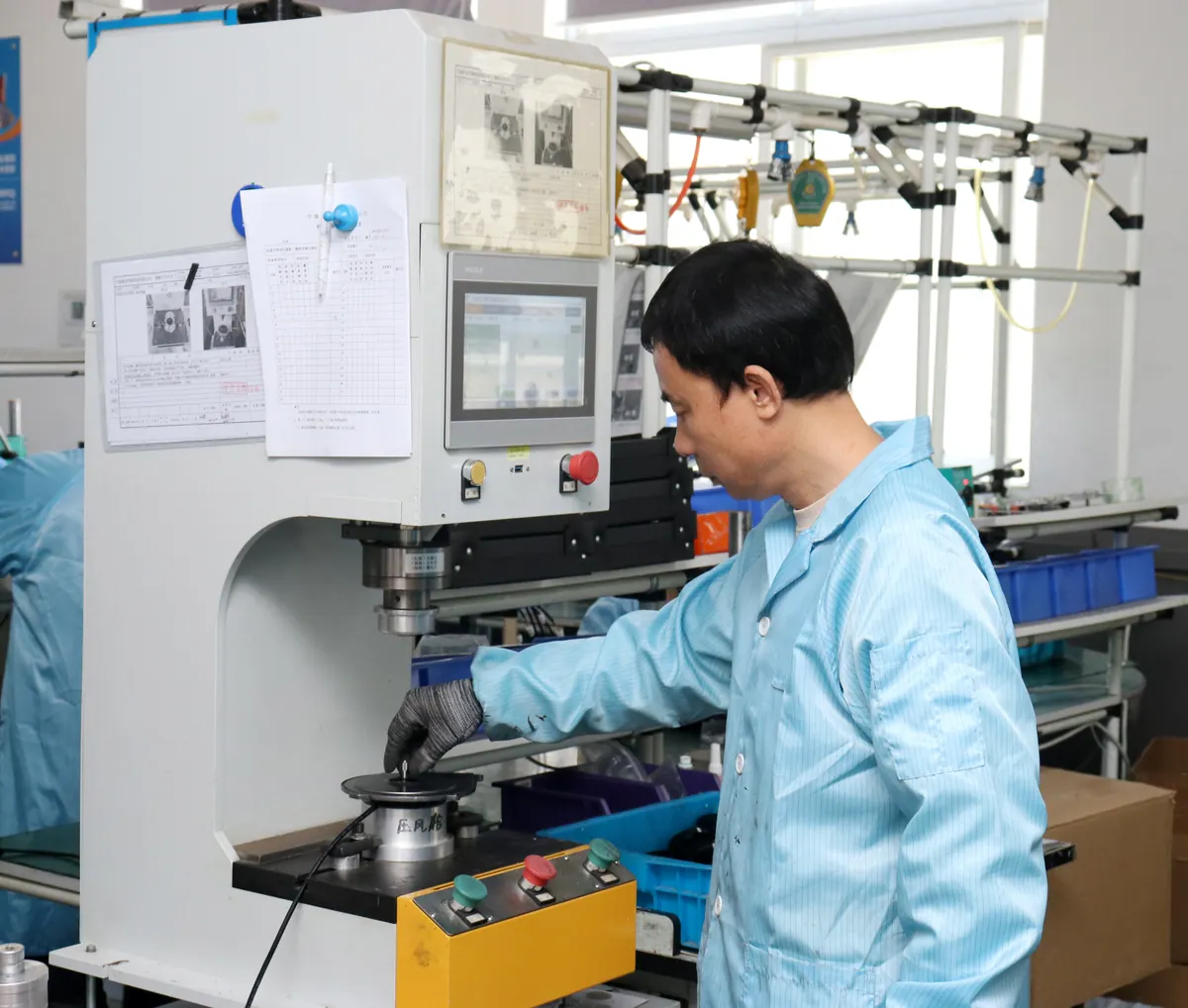
Blower production floor: equipment repeats controlled operations while personnel confirm the process and identify exceptions
8 Quality Management from Components to Customer Feedback
E-POWER's quality processes include incoming, in-process and finished-product inspections as well as equipment checks. Documentation, identification and traceability are organized around its ISO 9001 management system. Company materials also list optical three-dimensional measurement, magnetic-performance, stator, airtightness, aging and integrated finished-product testing equipment. These tools serve different quality stages and help establish the actual condition of components, assemblies and completed products.
For a blower, merely running at the factory is not a complete indication of quality. The motor and circuit board must meet electrical requirements, rotating parts need controlled balance, and assembly and sealing must remain consistent. The finished unit should also be checked under defined conditions. Multi-station testing and records make products within and across batches more comparable and help narrow the investigation when a problem appears.
Quality work does not end at shipment. Customer feedback, service records, corrective action and preventive action belong in the same loop. A field issue may originate in the blower or in equipment interfaces, control software or the operating environment. Recording the symptoms, conditions and sample identity before diagnosing the cause supports lasting improvement better than replacing a part immediately.
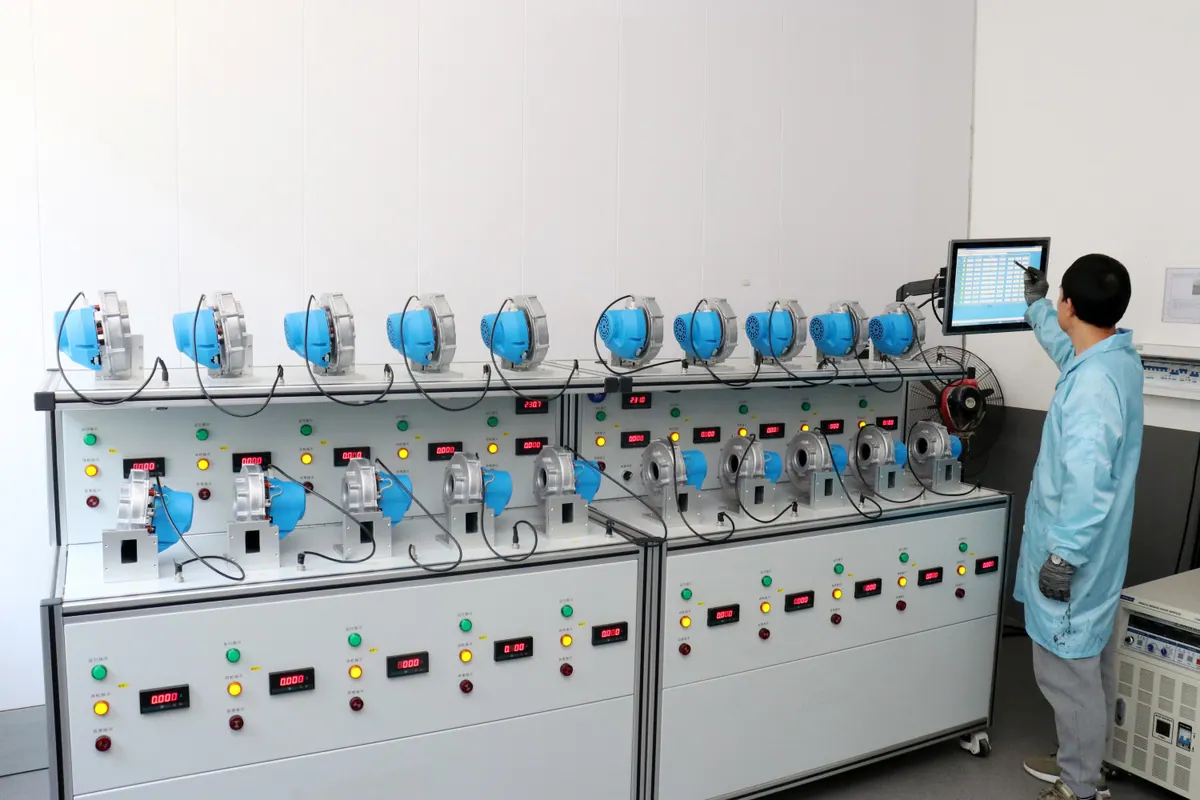
Multi-station finished-product testing and records provide comparable information across production batches
9 Start Project Collaboration with Actual Operating Conditions
Useful project discussions need not start with a lengthy technical document, but three groups of information are important. First are the targets: airflow, pressure, medium conditions and tolerances at minimum, rated and maximum load. Second are the boundaries: supply, control and feedback, inlet and outlet geometry, mounting space and environment. Finally, describe the current situation, including the installed model, available curves, measurements and the most important problem to solve.
Using these inputs, E-POWER can shortlist D-RG platforms and review mechanical, electrical and related-component interfaces with the customer before agreeing on samples or an assembly. Once a sample is installed, complete-equipment testing must check the operating point, noise, temperature rise, control response and application results. If results differ from expectations, investigate the aerodynamic boundary, measurement method, power supply and control program separately before attributing the issue to one component.
If you are developing new equipment or evaluating a replacement, share your operating conditions, drawings, control-signal definitions and any field measurements with E-POWER. We can then discuss the appropriate blower, fan, motor, controller or integrated assembly, followed by model-specific documentation and prototype validation. Clear operating boundaries make the first test more useful and later production changes easier to manage.